

From an investment perspective, Riley’s print market is best understood as a volume-led, low-volatility system. Demand is broad, repeatable, and international, while supply is finite but not artificially constrained. This balance has allowed her market to grow steadily without experiencing the sharp repricing cycles seen in more sentiment-sensitive print markets. As a result, capital deployed into Riley prints has historically prioritised preservation and incremental appreciation over rapid upside.
The charts referenced throughout update continuously as new sales occur. As a result, figures may occasionally differ slightly from those cited in the text.
Is Buying A Riley Print A Good Investment?
Over the past seven years, Riley’s print market has demonstrated a clear pattern of gradual expansion followed by consolidation, rather than boom-and-bust behaviour. Sales value and transaction volume have risen in tandem, with growth driven primarily by increased market participation rather than aggressive price inflation.
Between 2018 and 2020, Riley’s market expanded steadily as awareness of her print output broadened and institutional interest in female blue chip artists strengthened. From 2021 onward, this growth translated into higher annual sales values, culminating in a peak year in 2024. That peak, however, was not defined by a sudden surge in prices. Instead, it reflected a higher number of works trading across a consistent price band, reinforcing the market’s volume-led nature.
The pullback visible in 2025 should be read as a normalisation of supply. Transaction volume remained healthy relative to historical averages, while total sales value adjusted in line with fewer works coming to market. Importantly, there is no evidence of forced selling, price compression under stress, or a collapse in buyer participation. The market continues to function smoothly, absorbing fluctuations in availability without destabilising prices.
This pattern differentiates Riley’s print market from more volatile peers. Where speculative markets amplify both upside and downside through pricing elasticity, Riley’s market demonstrates resilience through consistency of trade. For investors, this behaviour signals a mature market where capital exposure is shaped more by structural participation than by timing risk.
What Happened In Riley's Print Market Performance In 2025?
The pullback visible in 2025 should be read as a normalisation of supply. Transaction volume remained healthy relative to historical averages, while total sales value adjusted in line with fewer works coming to market. Importantly, there is no evidence of forced selling, price compression under stress, or a collapse in buyer participation. The market continues to function smoothly, absorbing fluctuations in availability without destabilising prices.
This pattern differentiates Riley’s print market from more volatile peers. Where speculative markets amplify both upside and downside through pricing elasticity, Riley’s market demonstrates resilience through consistency of trade. For investors, this behaviour signals a mature market where capital exposure is shaped more by structural participation than by timing risk.
What Is The Average Value Of Riley Prints?
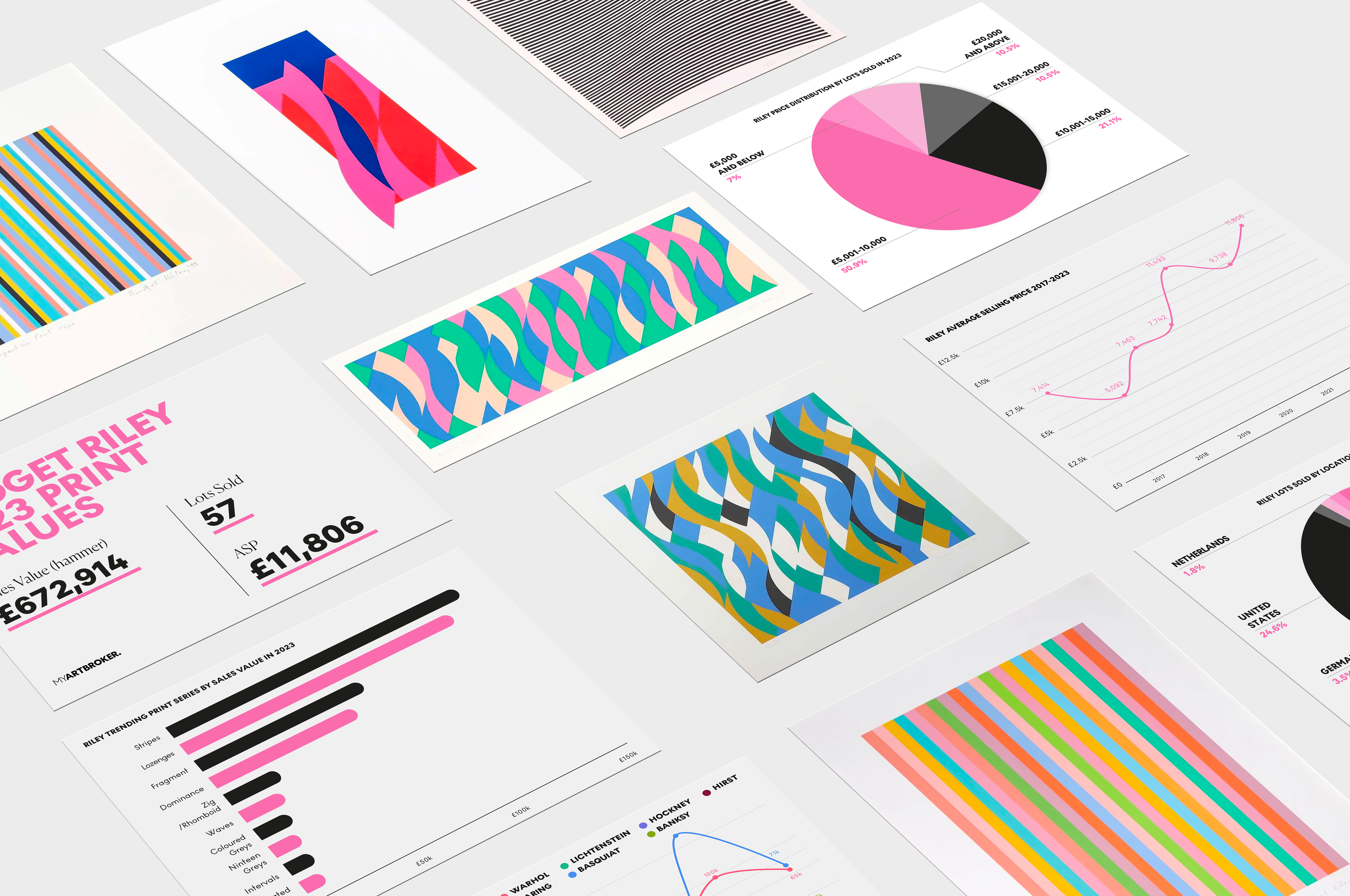
Riley’s average value growth has been gradual and measured, rising steadily through 2021 before stabilising and modestly softening as transaction volume increased.
The average value peak in 2023 coincided with a period of heightened demand for coloured and curved compositions, after which prices adjusted downward in 2024 and 2025 as a larger number of works entered the market. Crucially, this softening reflects a broadening of the buyer base, with increased participation at consistent price levels rather than repricing at the top.
This behaviour highlights a key structural feature of Riley’s market where price discipline is maintained even as liquidity increases. Where other print markets experience average value spikes during periods of enthusiasm, Riley’s market tends to distribute value across volume. As more works trade, average prices adjust marginally, preserving equilibrium rather than encouraging speculative acceleration.
Capital appreciation in Riley’s market is incremental and closely tied to long-term demand rather than short-term sentiment. The absence of sharp average value volatility reduces drawdown risk and supports Riley’s role as a stabilising allocation within a broader print portfolio.
Top Performing Print Collections In Riley's 2025 Market
The chart above shows how no single series dominates pricing behaviour or dictates overall performance in Riley’s 2025 print market. Instead, value is distributed across multiple bodies of work, each contributing under slightly different conditions but within a shared price discipline.
Lozenges led the year in both total sales value and lots sold, reflecting its role as one of the most consistently traded series in Riley’s market. Its prominence is not driven by speculative demand but by repeatability: recognisable imagery, manageable condition risk, and steady availability allow value to accumulate through volume rather than through isolated high-price events. This aligns with the wider market pattern in which participation, rather than pricing elasticity, underpins performance.
Stripes followed with lower transaction volume but comparatively strong aggregate value, indicating firmer pricing at the individual work level. This reflects sustained interest in Riley’s mature colour practice, where visual clarity and historical positioning support stable premiums without requiring frequent turnover. Importantly, this does not represent a break from the market’s volume-led structure, but rather a complementary layer within it.
Other series, including Movement, Waves, Magenta, Bagatelle, Coloured Greys, and Zig/Rhomboid, contributed more modestly to annual value while reinforcing overall market depth. Their presence ensures that value is not dependent on a narrow hierarchy of works and allows demand to express itself across a wide portion of Riley’s catalogue.
The Most In-Demand Works Within Our Network
The chart also helps contextualise the reduced visibility of Fragment works in 2025. Fragment remains a structurally important and historically significant series, but its plexiglass medium introduces heightened condition sensitivity. As buyer standards around condition have tightened, fewer examples are able to transact cleanly. Rather than indicating declining demand, this has shifted activity toward coloured series where condition risk is lower and supply can meet prevailing expectations more reliably.
Taken together, the series-level data supports the broader conclusion of this guide. Riley’s print market does not rely on headline collections or episodic repricing to function. Instead, value is sustained through diversification, substitution, and consistent participation across series, reinforcing a market that prioritises preservation and gradual appreciation over volatility.
Seven Blue Chip Artists Markets To Know
In a comparative blue-chip context, Riley’s print market occupies a distinct structural position. Unlike David Hockney’s market, which is driven by a combination of high transaction volume and a materially higher price ceiling, Riley’s market operates within a narrower value band, with performance shaped more by consistency of trade than by the presence of outsized individual results. This limits volatility but also caps short-term acceleration.
Relative to Damien Hirst, Riley’s market is less exposed to supply-side risk. Hirst’s print values are more sensitive to edition releases and shifts in collector appetite, whereas Riley’s output is finite and historically constrained, allowing pricing to adjust gradually rather than episodically. This difference becomes most visible during periods of broader market recalibration, where Riley’s values tend to soften through reduced volume rather than through price compression.
Compared to Tracey Emin, Riley represents a more mature and established print market. Emin’s recent growth has been supported by new editions and expanding participation, while Riley’s market is already operating at scale, with demand distributed across a well-defined catalogue. As a result, Riley’s performance is less reliant on novelty or institutional momentum and more closely tied to long-term collector behaviour.
Where To Start When Looking To Buy A Riley Print?
Riley’s print market is characterised by a pronounced concentration of activity at the lower end of the price spectrum. In 2025, over half of all transactions fell within the £5,000–£15,000 range, with a further significant share occurring below £5,000. This distribution reflects a market where liquidity is driven by volume rather than by high-value outliers, reinforcing Riley’s position as a structurally accessible blue chip print market.
The dominance of lower-value transactions indicates broad and repeatable demand, allowing price discovery to occur through frequency of trade rather than through episodic headline results. Higher-priced works above £15,000 represent a relatively small proportion of total transactions, underscoring that Riley’s market remains anchored by consistent participation rather than tiered speculation.
Prints to Invest in Below £15,000
The sub-£15,000 segment functions as the core engine of Riley’s print market, accounting for the vast majority of annual transactions. This segment supports liquidity, price stability, and market resilience. Works trading in this range circulate regularly across regions and auction platforms, enabling gradual price calibration rather than abrupt repricing.
Liquidity of Bridget Riley's Print Works
Higher-value works contribute meaningfully to annual sales value when they appear, but they do not drive day-to-day market activity. Instead, Riley’s market is supported by consistent trading across individual works and multiple series, allowing pricing to adjust through participation rather than through isolated results. This reduces dependence on singular auction moments and limits volatility during periods of fluctuating supply.
As a result, Riley’s print market continues to demonstrate reliable turnover and measured price behaviour, reinforcing its position as one of the more structurally stable segments within the British blue-chip print landscape.
Recent Market Performance And Current Opportunities
Riley’s print market remains geographically concentrated, with the United Kingdom accounting for approximately two-thirds of all lots sold. This reflects the market’s structural base: Riley’s institutional standing, collector familiarity, and auction infrastructure are most established domestically, supporting consistent transaction flow.
Outside the UK, the United States represents the largest secondary market, accounting for roughly 15% of lots sold. While smaller in absolute terms, this share indicates sustained international participation rather than isolated demand. Europe and Asia together make up a more limited portion of activity, suggesting that Riley’s market depth is still unevenly distributed by region.
For investors, this regional profile points to a market that is stable but not fully saturated. Liquidity is strongest where Riley’s reputation is most deeply embedded, while non-UK markets remain comparatively underdeveloped. Over time, any broadening of institutional exposure or collector education outside the UK is more likely to support gradual demand expansion than abrupt repricing, consistent with the market’s low-volatility characteristics.
Bridget Riley Top Selling Prints
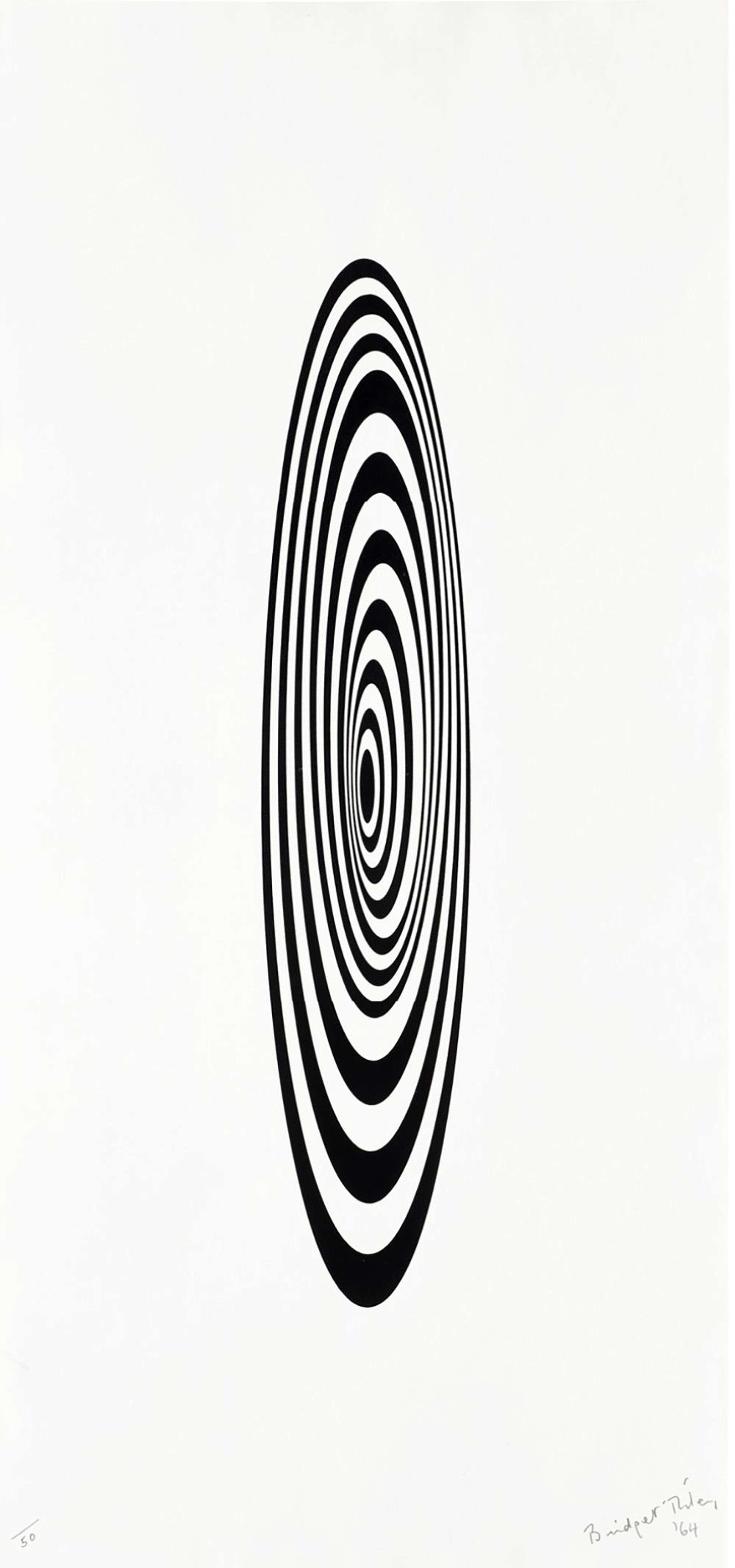
Untitled, Oval Image
Exceptionally rare, Untitled (Oval Image) is one of Riley’s earliest and most significant forays into printmaking, created in 1964. Produced during a transformative era when many artists were responding to post-war figuration and symbolism, Riley’s hypnotic use of the spherical oval introduced a strikingly different visual language. With an edition of just 50, the work is scarcely seen on the market. When it resurfaced for the first time in 14 years at Phillips' June Editions sale, it ignited a bidding war and set a new auction record for Riley’s print market, achieving £82,550.
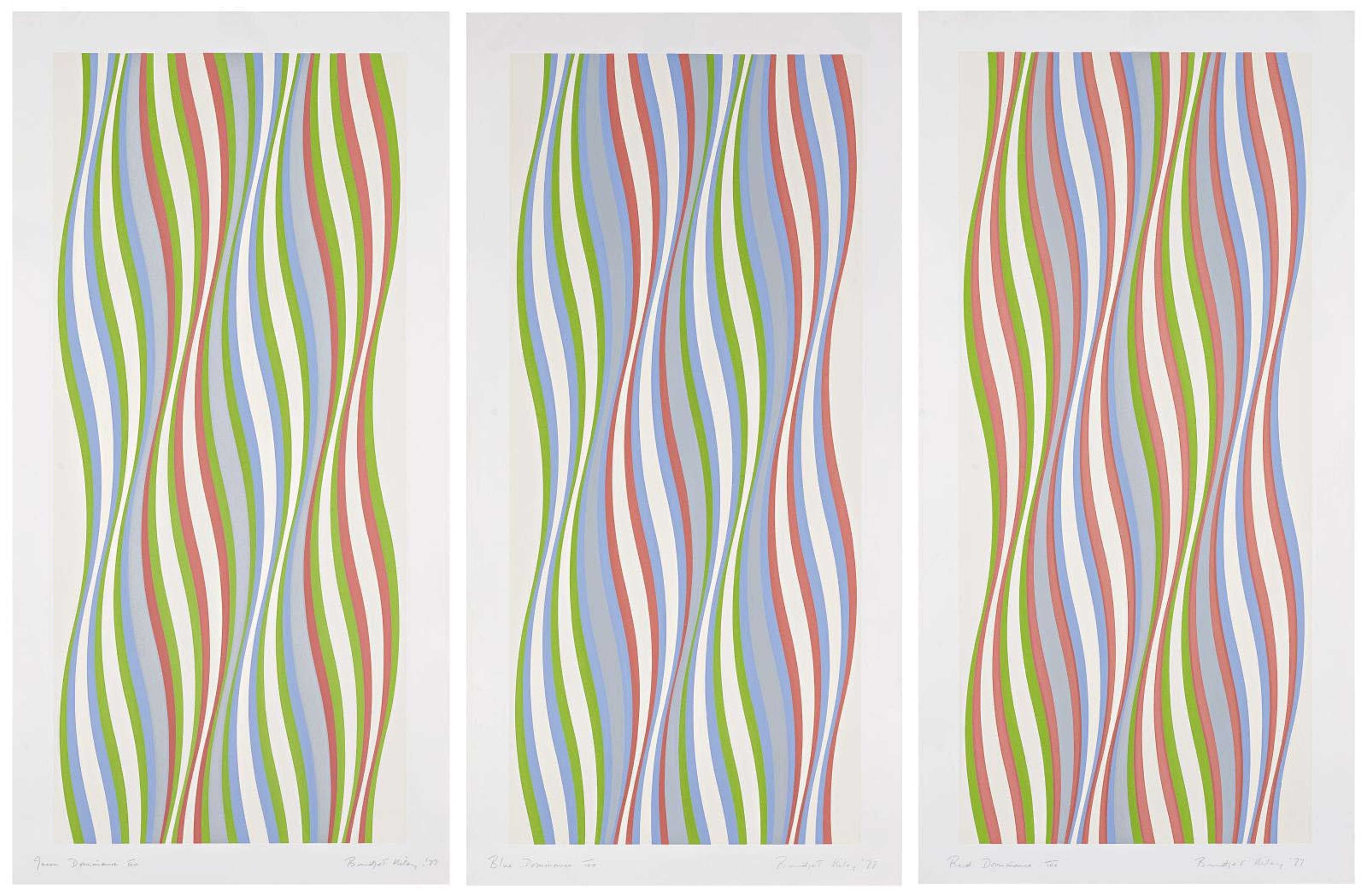
Green Dominance, Blue Dominance, Red Dominance
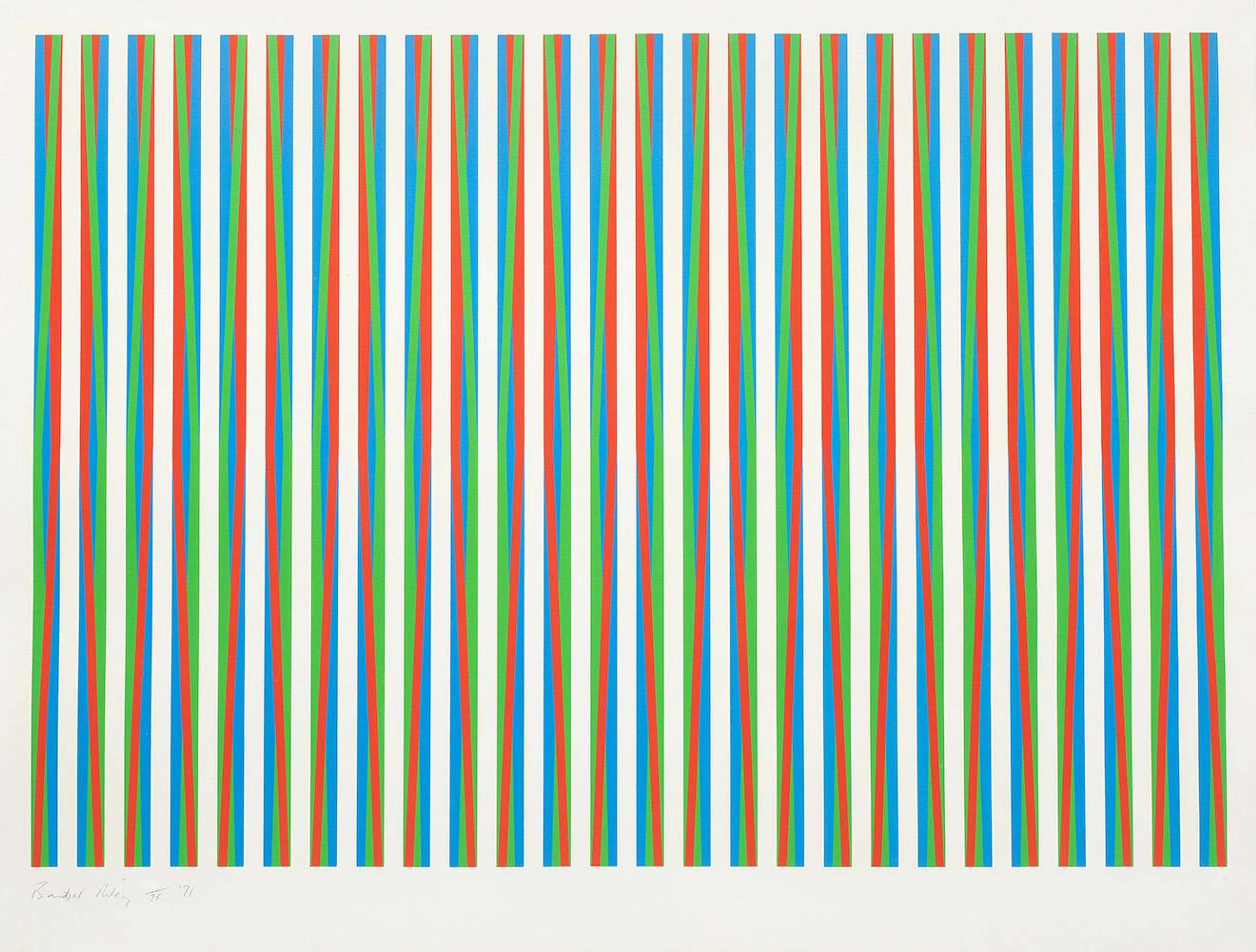
The complete set of Green Dominance, Blue Dominance, Red Dominance forms Riley’s Dominance series produced in 1967. Each work features precisely rendered vertical lines in shifting colour palettes, creating a dynamic optical effect emblematic of Riley’s transition into the Polychrome Op Art period. This marked a significant departure from her earlier monochromatic focus and signalled a bold exploration of colour. Rarely seen on the market - particularly as a complete set - the series reappeared in 2023 at Leslie Hindman Auctioneers in Chicago, its first public sale since 2020. The set achieved a record-breaking £70,854, more than doubling its previous sale value.
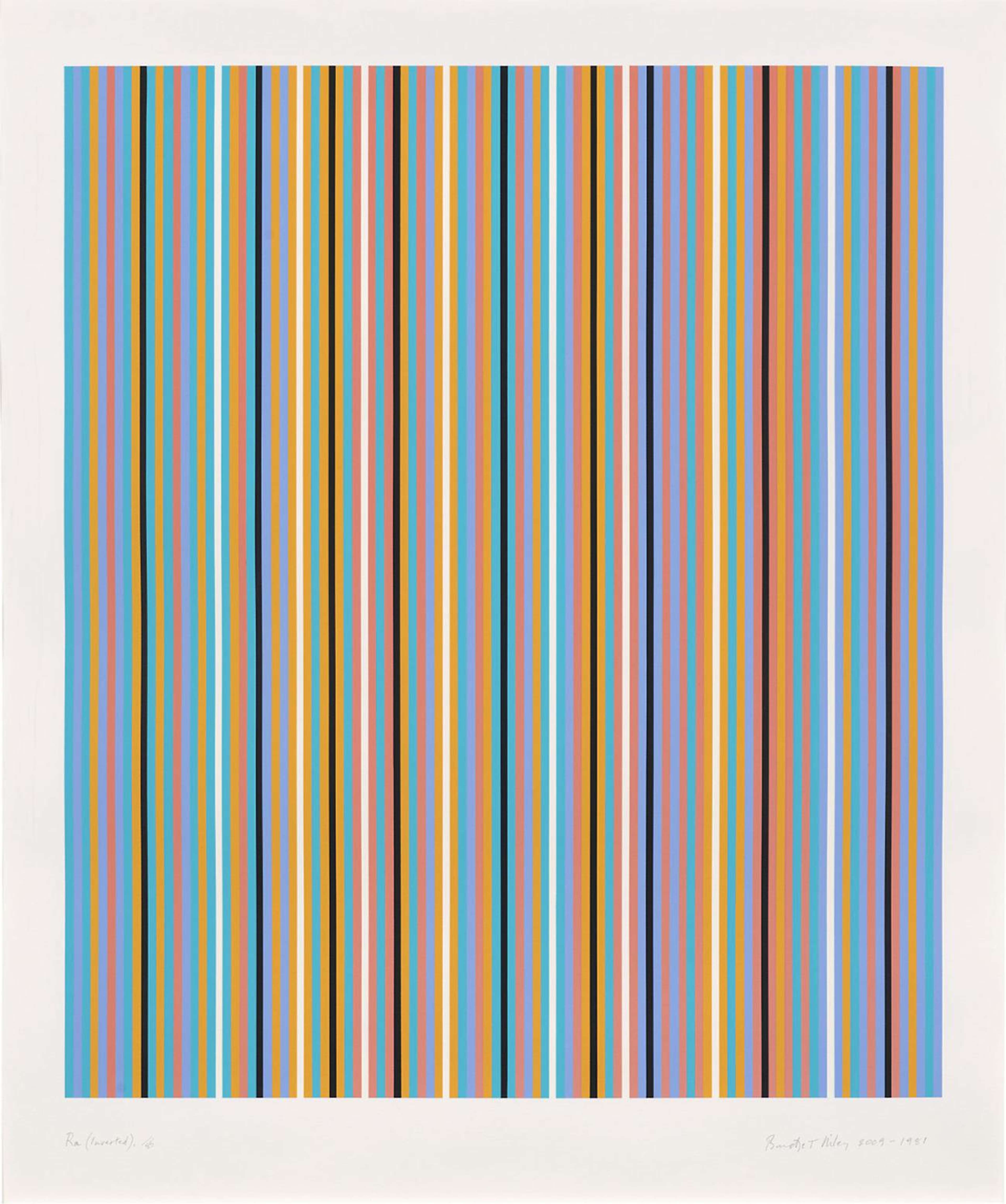
RA (Inverted)
RA (Inverted) features slender vertical bands in a rotating colour spectrum, punctuated by carefully placed black and white lines that subtly alter how the surrounding colours are perceived. The black lines intensify saturation and depth, while the white brings clarity and brightness, resulting in a crisp, vibrant composition. Riley’s precise command of colour and geometry produces a captivating optical effect. Rare to market, this work resurfaced in 2023 for just its third public auction appearance, selling for £44,100 with fees - doubling its previous result since last seen in 2020.