

Key Takeaways
- Decide which period you're buying into – early 1960s black-and-white Op Art works behave very differently from later colour editions.
- Prioritise condition, especially for Perspex Fragment prints where surface damage cannot be corrected.
- Availability drives Riley prices more than edition size – some works from large editions rarely surface.
- Compare sales within the exact series, not overall market averages.
- Look beyond the Big Three auction houses – 70% of Riley prints have sold elsewhere since 2024.
Why Collect Bridget Riley Prints?
Riley's print market is structurally broad and liquid. Since 2024, 194 prints have sold at auction, generating over £1.7m in total value. 86% trade under £15,000, making this a market sustained by distributed collector demand across accessible price levels rather than a handful of trophy results.
Riley treated printmaking as an independent medium, not a reproduction of her paintings. She worked closely with master printers at studios including Kelpra Studio to achieve the optical precision her compositions demand. That distinction matters for buyers – these are autonomous works with their own market dynamics.
Are Bridget Riley Prints a Good Investment?
Riley's market rewards informed selection rather than speculation. It is volume-led and low-volatility: demand is broad, repeatable, and international, while supply is finite but not artificially constrained. Capital deployed into Riley prints has historically prioritised preservation and incremental appreciation over rapid upside.
However, returns vary significantly by period. Early 1960s black-and-white works such as Untitled (Based On Blaze) and Untitled (Based On Movement In Squares) are among her highest valued – the latter reached £63,500 at Christie's London in 2025. Her black-and-white Fragment prints on Perspex have also been market favourites, though values have eased in recent years as good-condition examples have become harder to source. Later monochrome series such as Bagatelle trade at significantly lower levels, illustrating how period context drives value more than visual similarity.
For a deeper breakdown of long-term liquidity and price behaviour, consult our dedicated Bridget Riley Investment Guide.
How Much Are Bidget Riley Prints Worth?
Riley print prices segment into three broad tiers:
- Under £15,000: The majority of the market. Colour screenprint editions from the Lozenges, Stripes, Waves, and Egyptian period series (Zig/Rhomboid, Nineteen Greys, Elongated Triangles), plus later black-and-white works. Riley's colour prints have gained significant popularity in recent years, sustaining strong liquidity at this level.
- £30,000–£50,000: Fragment prints on Perspex and stronger-performing Stripes works such as RA 2 and Silvered 2 sit in this tier
- £70,000+: Only two Riley prints have reached this level – Untitled (Oval Image), the current auction record at £82,550 (Phillips, 2024), and a rare complete Dominance set that sold for £70,849 at Hindman in 2023.
What Determines the Value of a Bridget Riley Print?
Five factors shape pricing across Riley's output:
1. Period and series Early black-and-white works (1962–64) occupy a distinct tier due to their art-historical significance. Later colour editions operate within a broader, more liquid price band. Within the colour market, series identity matters – Zig/Rhomboid prints like New Day and Fête have traded well above typical colour series averages.
2. Condition Riley's compositions rely on optical precision, so even slight fading, toning, or surface damage is more visible than in many other print markets. This is especially acute for Perspex Fragment prints, where scratches and clouding cannot be corrected. Condition directly determines whether a print trades at the top or bottom of its series range.
3. Colourway and visual impact In series like Lozenges and Stripes, palette, scale, and composition often influence pricing more than edition size. Buyers regularly pay a premium for specific colour combinations.
4. Availability Some works from larger editions command stronger prices simply because they rarely appear for sale. What matters is not just how many were printed, but how many are currently accessible.
5. Venue Since 2024, 70% of Riley prints have traded outside Christie's, Sotheby's, and Phillips. This creates price dispersion between venues – and opportunity for informed buyers.
What Types of Bridget Riley Prints Can You Buy?
Bridget Riley Early Black-and-White Prints (1960s)
Works such as Untitled (Based On Movement In Squares), Untitled (Based On Blaze), and Untitled (Oval Image) represent Riley's formative Op Art period. Created as screenprints on wove paper, these are the most art-historically significant prints in her catalogue and attract institutional-level demand. Supply is extremely limited.
Bridget Riley Fragment Prints on Perspex
The Fragment series consists of seven variations printed on Perspex, created in 1965 in a limited edition of 75. These remain an integral part of Riley's practice and continue to attract collector interest, but supply has tightened as stronger examples are held. Buyers considering a Fragment should always seek independent condition assessment before committing.
Bridget Riley Colour Screenprints: Lozenges, Stripes, Waves, and Dominance
Riley's colour market is the largest and most varied segment, and offers the widest range of entry points.
Lozenges are the most liquid part of the market. At least 22 variations exist, with edition sizes from 50 to 300. Buyers should compare within the series as not all Lozenges are equivalent.
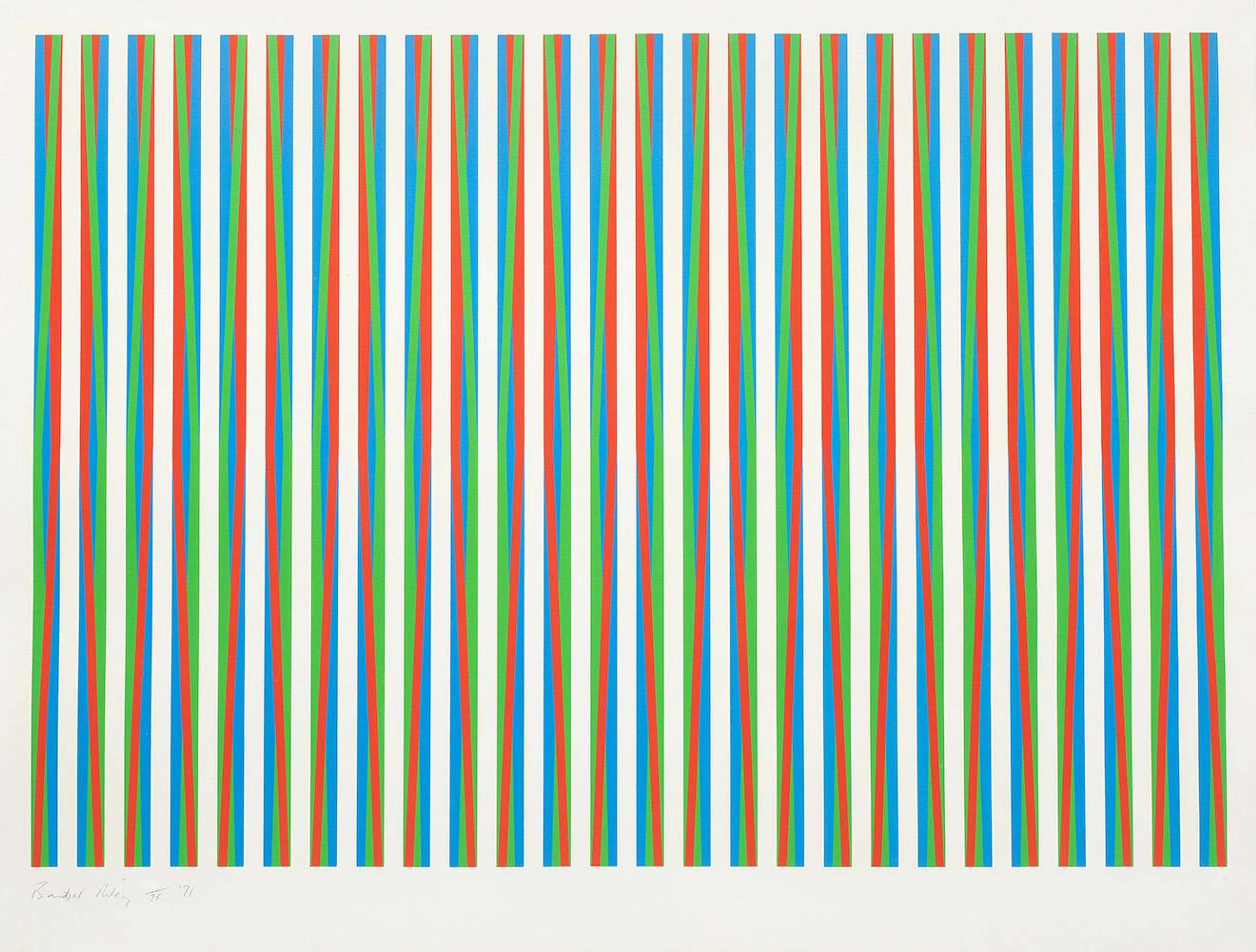
Stripes include some of the stronger-performing colour works. RA 2, Silvered 2, and Firebird have consistently attracted buyer interest, while works like Achaen are extremely rare on the secondary market.
Dominance (Green, Blue, Red) prints are most compelling as a complete set. Individual works surface occasionally, but complete groupings are rare.
Waves offer consistent activity at more accessible price points – a practical entry for collectors drawn to Riley's colour work.
Bridget Riley's Egyptian Period and Geometric Series
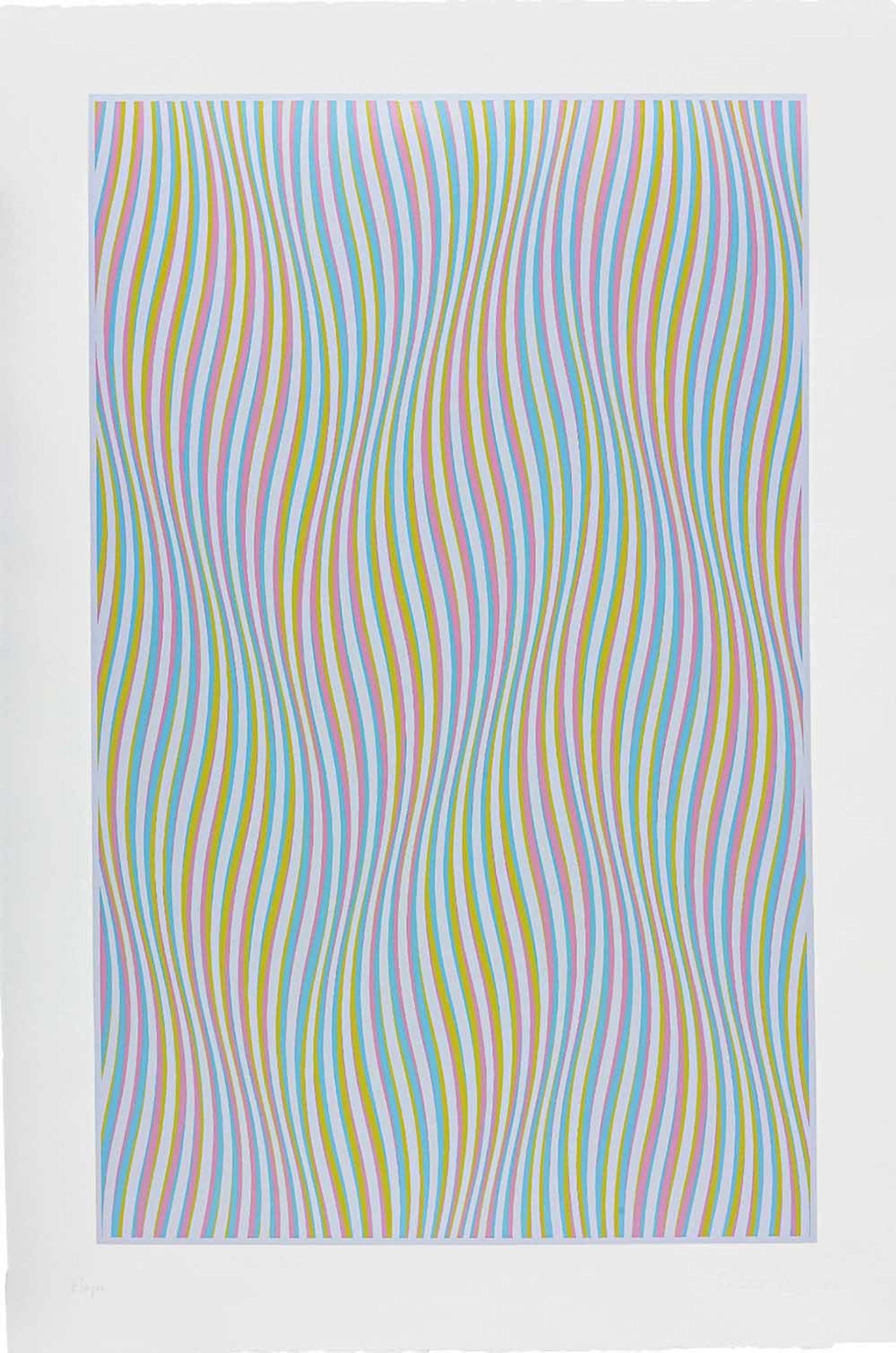
Riley's Egyptian-influenced works – Zig/Rhomboid, Nineteen Greys, Elongated Triangles, and Composition With Circles – are often overlooked. Zig/Rhomboid prints such as New Day and Fête have shown particular strength. Nineteen Greys complete sets attract consistent demand. These carry smaller market footprints but offer selective opportunities for collectors drawn to Riley's geometric vocabulary beyond Lozenges and Stripes.
Bridget Riley Later Black-and-White Editions (e.g., Small Bagatelle)
Riley's return to black-and-white in later decades trades at significantly lower price points than the 1960s works. Attractive for collectors who want the monochrome aesthetic at a more accessible entry – but not to be confused with the valuation tier of her early Op Art screenprints.
What Are the Most Popular Bridget Riley Prints?
Interest tends to cluster around specific series and structurally important works rather than a single iconic image.
Green Dominance, Blue Dominance, and Red Dominance (Complete Set) – Compelling for the colour cohesion and conceptual unity across all three works. Only one complete set has traded publicly – at Hindman in 2023 for £70,849.
Firebird (Stripes Series) – One of the more recognisable Riley Stripes prints, combining strong vertical rhythm with high visual impact. Firebird reached £20,000 at Bonhams in 2024.
RA 2 (Stripes Series) – Among the strongest-performing Stripes prints, with multiple sales above £19,000. For buyers, it offers established market demand and relative scarcity.
How to Buy Bridget Riley Prints
Browse Bridget Riley prints on the Trading Floor and speak to a specialist if you are looking to buy with specific condition, series, or budget requirements.
How to Authenticate a Bridget Riley Print Before Buying
Riley signed and numbered her editioned prints – most authentic works carry a handwritten signature and edition number in pencil. However, edition sizes vary widely across her output, so buyers should always confirm that the stated edition matches documented records for that specific print.
Exhibition posters, later reproductions, and works from varied publishers circulate alongside signed editions. Careful verification is essential.
The Bridget Riley Catalogue Raisonné
Print editions are documented in Bridget Riley: The Complete Prints 1962–2020, the primary reference for verifying edition details, publisher information, and authorised impressions. Buyers should confirm that any print they are considering corresponds with its catalogue entry.
Does the Bridget Riley Art Foundation Authenticate Prints?
The Bridget Riley Art Foundation maintains a research archive but does not offer authentication services to the public. Authentication in Riley's market is documentation-led – it relies on the catalogue raisonné, signature and edition verification, publisher records, and provenance. Buyers should work with specialist dealers or platforms that conduct these checks independently.
What to Check Before Buying a Bridget Riley Print
- Signature style and numbering consistent with the catalogue raisonné entry
- Publisher details and confirmed print medium (screenprint, lithograph, or giclée)
- Provenance documentation – gallery invoices, exhibition history, or prior auction records
- Independent verification through a specialist platform, particularly for works with limited documentation
How to Check the Condition of a Bridget Riley Print
Condition should be assessed differently depending on the material.
Fragment Prints on Perspex
Inspect for scratches, scuffs, clouding, edge chips, and handling marks under direct light. Perspex is far less forgiving than paper – damage cannot be easily corrected or restored.
Paper-Based Screenprints
For works on paper – including early black-and-white prints and colour screenprints – look for fading, toning, foxing, creases, hinge marks, trimming, and signs of over-cleaning or restoration.
What to Request Before Purchasing
- A detailed condition report for the specific impression
- High-resolution images in raking light
- Confirmation of any restoration or conservation history
A cleaner example almost always justifies a premium. When in doubt, seek independent review or buy through a platform that conducts condition assessments as standard.
Where to Buy Bridget Riley Prints
Riley prints can be acquired through auction houses, regional platforms, art fairs, galleries, and private sale brokers.
Buying Bridget Riley Prints at Auction
Auction offers price transparency and competitive bidding. Buyers should factor in premiums (often 25%+), applicable taxes, and the possibility of competitive escalation on high-demand lots.
Buying Bridget Riley Prints Through Private Sale
Private sale offers discretion, price negotiation, and access to works that may never appear publicly – especially higher-condition examples. For buyers seeking specific series or condition thresholds, private sourcing can be more efficient than waiting for auction supply.
Combining auction monitoring with private access typically produces the strongest acquisition strategy.
Why Buy Bridget Riley Prints Through MyArtBroker?
Access to Bridget Riley Prints on the Trading Floor
Our Trading Floor connects buyers with a global network of collectors actively trading Riley prints, including works that may not reach public auction.
Bridget Riley Print Valuations and Market Data
Our Instant Valuation tool shows how a specific print sits within current market ranges, framing negotiations on recent comparable transactions rather than isolated headline results.
Specialist Verification for Bridget Riley Prints
We assess each work for condition, edition structure, and provenance alignment before facilitating a transaction – reducing acquisition risk and ensuring the price reflects the actual quality of the impression.