Key Takeaways
The medium premium is narrowing – but only for prints that have already proved themselves. The June auctions showed exactly what that looks like.
At Art Basel, Gray Gallery sold David Hockney’s Studio Interior #2 for $8.5 million alongside an edition from the Arrival of Spring series for $650,000. Rather than treating editions as a separate category, the market is increasingly distinguishing between individual works across different mediums within the same artist’s market. The same pattern continued through the June auctions, where exceptional originals and a small number of editioned works attracted similarly concentrated demand.
Hockney’s Arrival of Spring: What The Edition Gap Reveals
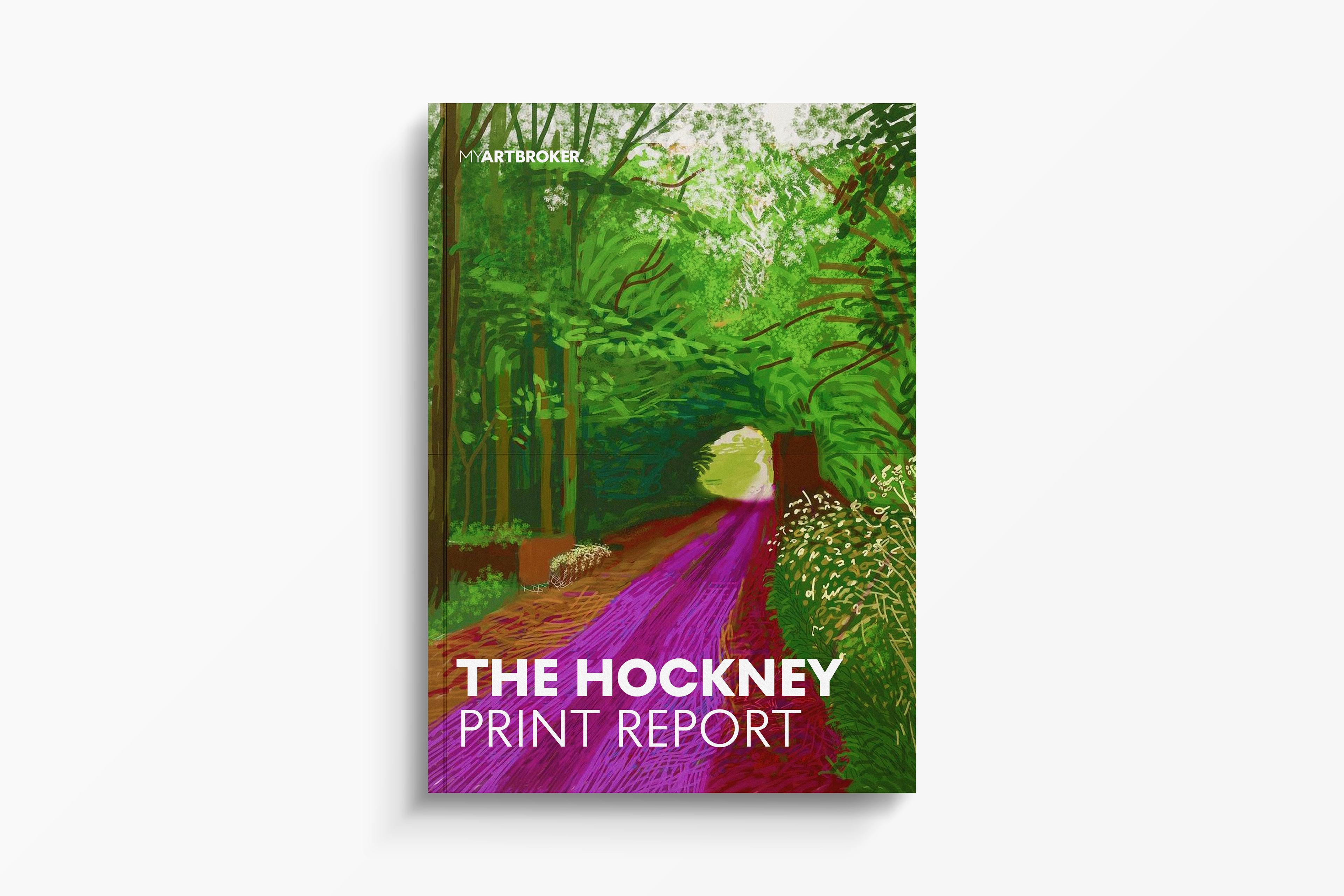
Hockney’s Arrival of Spring makes the argument at the series level. Long before the recent surge in attention following his death, the series had emerged as one of the defining bodies of work from his later career. The more interesting question now is how collectors are distinguishing between works within the series itself. Historically, the larger-format edition of 10 commanded a substantial premium over the smaller-format edition of 25 – a gap of close to 2:1. That has compressed to under 1.2:1 as prices for the edition of 25 have risen sharply. Sotheby's June sale, in which Arrival of Spring, 30th May – a previously unseen edition of 10 – realised £512,000 with fees, confirms that collectors still place particular importance on the rarest and most ambitious works within the series, even as demand broadens across the wider market.
This is the anatomy of a series being valued not simply as a print series, but as one of the defining bodies of work from Hockney’s later career – with pricing behaviour that reflects that status across all format sizes.
Lichtenstein's Nudes: Screenprints That Now Trade at £561,000
Roy Lichtenstein’s June results at Sotheby's Contemporary evening sale present a more specific picture than the medium hierarchy framing usually allows. Landscape With Grass was withdrawn carrying a £3 million high estimate; Despair cleared just above its low at £1.1 million with fees. Meanwhile Nude With Blue Hair – a screenprintprint, one of the most formally demanding works Lichtenstein made in any medium – sold at Christie’s in April 2026 for £561,800 with fees as a standard main edition impression.
Auction data from 2023 onwards suggests the Nudes series is undergoing something closer to revaluation than appreciation: estate sale APs achieving £347,000 to over £1 million with fees between 2024 and 2025, with the April 2026 Christie’s result confirming that institutional pricing has extended beyond estate-provenance impressions into the open market. Collectors facing a choice between a Lichtenstein canvas at £1–3 million and a Nudes screenprint at around £561,000 are making an active medium choice rather than defaulting to canvas – and the Nudes’ repeated results above £300,000 since 2024 confirm this is an established pattern, not an anomaly.
What has changed is not the appetite for Lichtenstein prints in general. The Mirrors series continues to trade at £5,000–£15,000.
Same artist. Same medium. Entirely different market position.
Instead, specific works within his print body have earned a different category of recognition and demand. For works that have already accumulated that institutional credibility through sustained auction history, the medium premium appears to be narrowing.
Banksy's Kate Moss AP: When Supply Is Too Thin For The Framework To Form
Sotheby’s Contemporary June sales also placed two Banksy results in the same cycle. Love Is In The Air – a life-size canvas making its auction debut – achieved £6.4 million with fees. A rare artist’s proof of Kate Moss, dual-signed by both Banksy and Kate, and also never previously at auction, achieved £179,200 against a £70,000 high estimate – more than double the standard edition’s trading range of £80,000–£95,000, and the highest AP result in Banksy’s auction record since 2023. Earlier that month, Phillips offered a never-before-seen artist’s proof of Gangsta Rat (Dark Grey), which realised £116,100 against a £50,000–£100,000 estimate. Together, the two results reinforce the exceptional demand currently surrounding Banksy’s rarest artist’s proofs.
The contrast with Hockney and Lichtenstein is instructive. Both markets have accumulated years of auction evidence, allowing collectors to price their strongest editions with increasing confidence alongside the artists’ original works. Banksy’s artist’s proofs operate differently. Supply is so limited that each appearance functions as an isolated pricing event rather than another data point within an established market.
Across the past three and a half years, fewer than a dozen artist’s proofs have appeared at auction across Banksy’s entire print body. There is simply not enough transaction history for pricing to stabilise. Choose Your Weapon APs sold for £100,000 at Christie’s and £57,600 at Bonhams within the same month in 2023. With only a handful of comparable sales, condition, provenance and the significance of the individual work explain pricing as much as broader market dynamics.
Banksy has developed a de facto two-tier structure without designing one: APs function as near-unique works not because collectors apply different criteria to them, but because supply is so constrained that every appearance becomes a new price discovery event. The Kate Moss result shows exactly what those events can achieve at their strongest. What it does not yet show is the kind of sustained auction history that has allowed markets such as Hockney’s Arrival of Spring or Lichtenstein’s Nudes to establish a different category of demand.
What This Means For Print Collectors
What connects Hockney and Lichtenstein – and separates both from Banksy’s print market – is accumulated evidence.
In a more cautious buying environment, collectors are not simply responding to quality as an abstract idea. They are looking for works whose importance has already been tested: by auction history, institutional attention, and sustained collector demand. The strongest print markets are no longer being defined primarily by the fact that they are editions. A small group of works are increasingly being valued according to the same factors that drive demand for major paintings: their position within an artist’s oeuvre, their market history, and their cultural significance.
That is what is compressing the medium premium in the most established print markets – and what keeps it wide where the track record has not yet formed. For collectors already holding works in these markets, the June results reinforce the strength of markets that have already accumulated years of supporting evidence. For collectors considering entry, the question is not whether prints can trade like paintings. It is whether the specific work has done the work to earn that position, and what the evidence looks like.