Kanarische Landschaften I - b
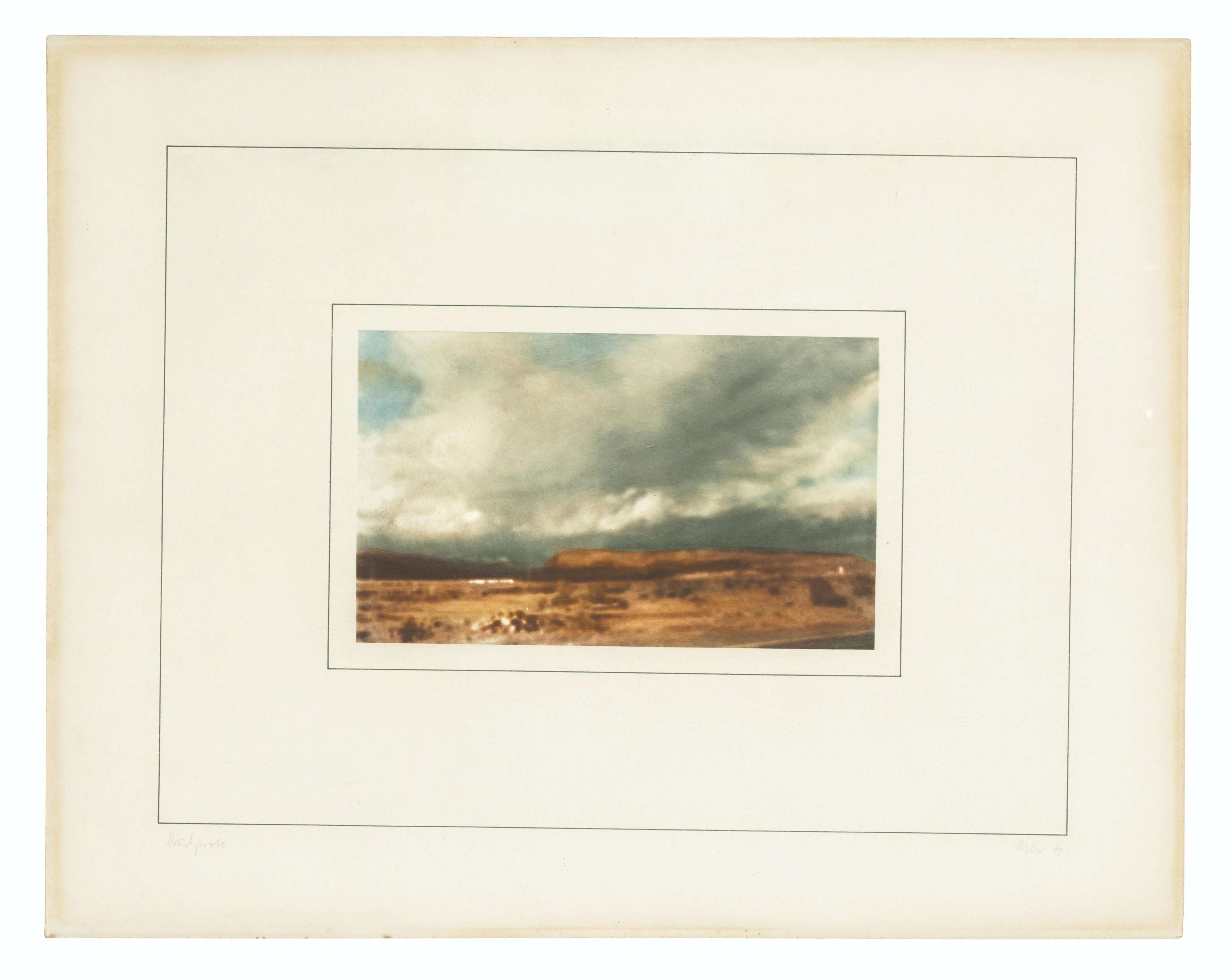
Kanarische Landschaften I - b
Signed Print
Gerhard Richter
40 x 50cm, Edition of 100, Photographic print, 1971
£1,250-£1,850
$2,350-$3,500 Market Value Indicator
$2,350-$3,450 Market Value Indicator
¥11,000-¥16,000 Market Value Indicator
€1,450-€2,150 Market Value Indicator
$13,000-$19,000 Market Value Indicator
¥260,000-¥390,000 Market Value Indicator
$1,650-$2,450 Market Value Indicator
There aren't enough data points on this work for a comprehensive result. Please speak to a specialist by making an enquiry.
Track auction value trend
Meaning & Analysis
Kanarische Landschaften I – b is a 1971 colour photographic print by Gerhard Richter from the Kanarische Landschaften I (Canary Island Landscapes I) series, produced in a signed edition of 100. The work presents a wide, open view of the volcanic terrain of the Canary Islands – an amber plain extending to a low, flat-topped mesa on the horizon, beneath a sky filled with massed, heavy cloud formations.
The Kanarische Landschaften series represents a sustained engagement with landscape through the medium of photography, sitting alongside but distinct from Richter's better-known painted works. Made from the artist's own photographs of the Canary Islands rather than found or appropriated imagery, the prints are presented with deliberate modesty: each image mounted small and centrally on a large cream-white sheet with a hand-drawn pencil border.
In Kanarische Landschaften I – b, the composition is particularly expansive. The flat, ochre and amber terrain of the foreground occupies only the lower quarter of the image, leaving the remainder to the sky and its heavy, shifting cloud formations. A flat-topped volcanic mesa sits on the horizon, low and distant. The slight blur of Richter's photographic exposure – a quality found consistently across the series – gives the scene an unstable, just-out-of-reach character. What should be a factual landscape record becomes something more ambiguous.
This quality – the slippage between description and atmosphere – is central to the series. Made in 1971, the Kanarische Landschaften photographs are not documents of a place but propositions about what a photograph of a place can be.