Details Of Renaissance Paintings (Sandro Botticelli, Birth Of Venus, F. & S. II.316 - 319) (complete set)
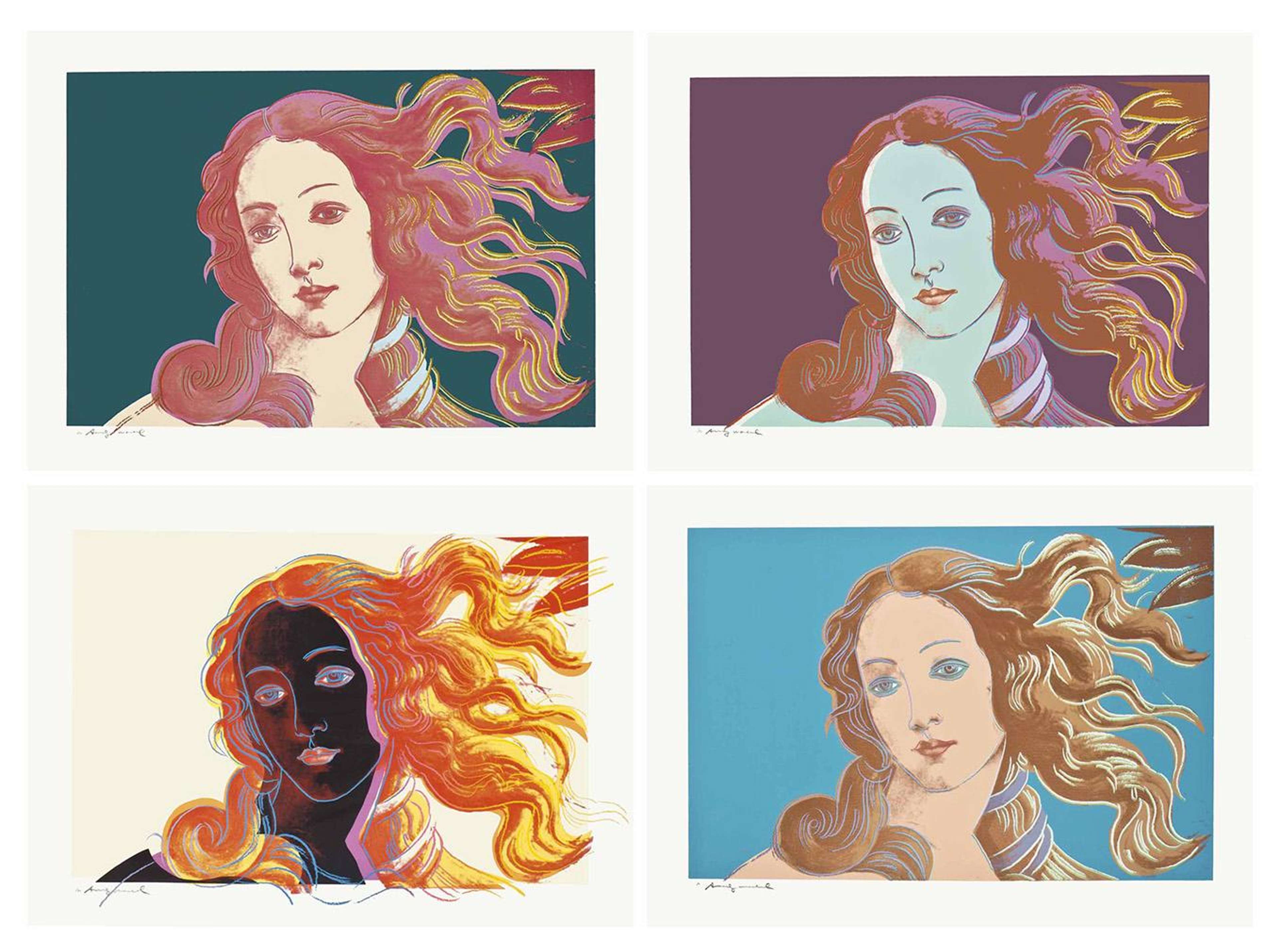
Details Of Renaissance Paintings (Sandro Botticelli, Birth Of Venus, F. & S. II.316 - 319) (complete set)
Signed Print
Andy Warhol
64 x 94cm, Edition of 70, Screenprint, 1984
£370,000-£560,000
$700,000-$1,050,000 Market Value Indicator
$690,000-$1,050,000 Market Value Indicator
¥3,290,000-¥4,980,000 Market Value Indicator
€430,000-€650,000 Market Value Indicator
$3,850,000-$5,820,000 Market Value Indicator
¥77,620,000-¥117,470,000 Market Value Indicator
$490,000-$740,000 Market Value Indicator
There aren't enough data points on this work for a comprehensive result. Please speak to a specialist by making an enquiry.
Track auction value trend
Meaning & Analysis
Details of Renaissance Paintings (Sandro Botticelli, Birth of Venus) is a complete set of four screenprints produced in 1984 as part of Warhol's Renaissance Paintings series. Each print reproduces a tight close-up of Venus's face and flowing hair from Botticelli's Birth of Venus, rendered across four colourways spanning teal, aubergine, cream, and blue grounds. Signed and numbered from an edition of 70.
Botticelli's Birth of Venus is among the most reproduced images in Western art – a fact Warhol was acutely aware of when he chose to isolate Venus's face and hair for his 1984 Renaissance Paintings series. By cropping the composition to a close-up, he removed the allegorical apparatus – the shell, the wind-gods, the attendant figure – and left only the face: a commercial close-up, the scale of a magazine cover.
The four colourways transform Venus into four distinct registers. The teal-ground version renders her in warm pinks and amber-gold, keeping something of Renaissance warmth within an unnaturalistic field. The aubergine variant cools her to icy blue, the face almost glacial. The sky-blue version returns her to something approaching naturalism, the caramel-brown hair reading closest to Botticelli's original. The most arresting is the cream version, where Venus's face is entirely silhouetted in black, her flowing hair blazing in orange and gold – the Renaissance ideal of feminine beauty converted into its photographic negative.
The series anticipates later debates around appropriation and the mass reproduction of the masterpiece, and remains one of Warhol's most pointed late-career commentaries on art history as image bank.