

How Much Are Roy Lichtenstein Prints Worth in 2026?
Roy Lichtenstein's print market spans a remarkably broad price range, from later editions and abstract works available for under £50,000 to multi-million-pound results for the rarest and most sought-after impressions.
At the very top of the market are Lichtenstein's exceptionally rare enamel-on-steel editions. The auction record for a Lichtenstein print remains Vicki! I – I Thought I Heard Your Voice (1964), which achieved £5.8 million at Sotheby's in 2019. Produced in extremely small numbers, these works occupy the highest tier of Lichtenstein's print hierarchy and rarely appear at auction.
Most collectors, however, participate in a different part of the market. The strongest demand has recently centred on collections such as Water Lilies, Nudes and Reflections, where scarcity, image, and impression type combine to produce some of the artist's highest prices. Lichtenstein's print market, however, is broad, and offers collector opportunities across a wide range of budgets, making it possible to collect museum-quality works without competing at the very top of the market.
Under £50,000 Roy Lichtenstein Prints
This price range provides the most accessible entry point into Lichtenstein's print market. Collectors will typically find works from later abstract and architectural series, including Perfect/Imperfect, Entablature, Mirrors, Landscapes and selected Composition prints. Theses works showcase the technical precision and conceptual experimentation that define some of Lichtenstein's earliest printmaking practice.
£50,000–£90,000 Roy Lichtenstein Prints
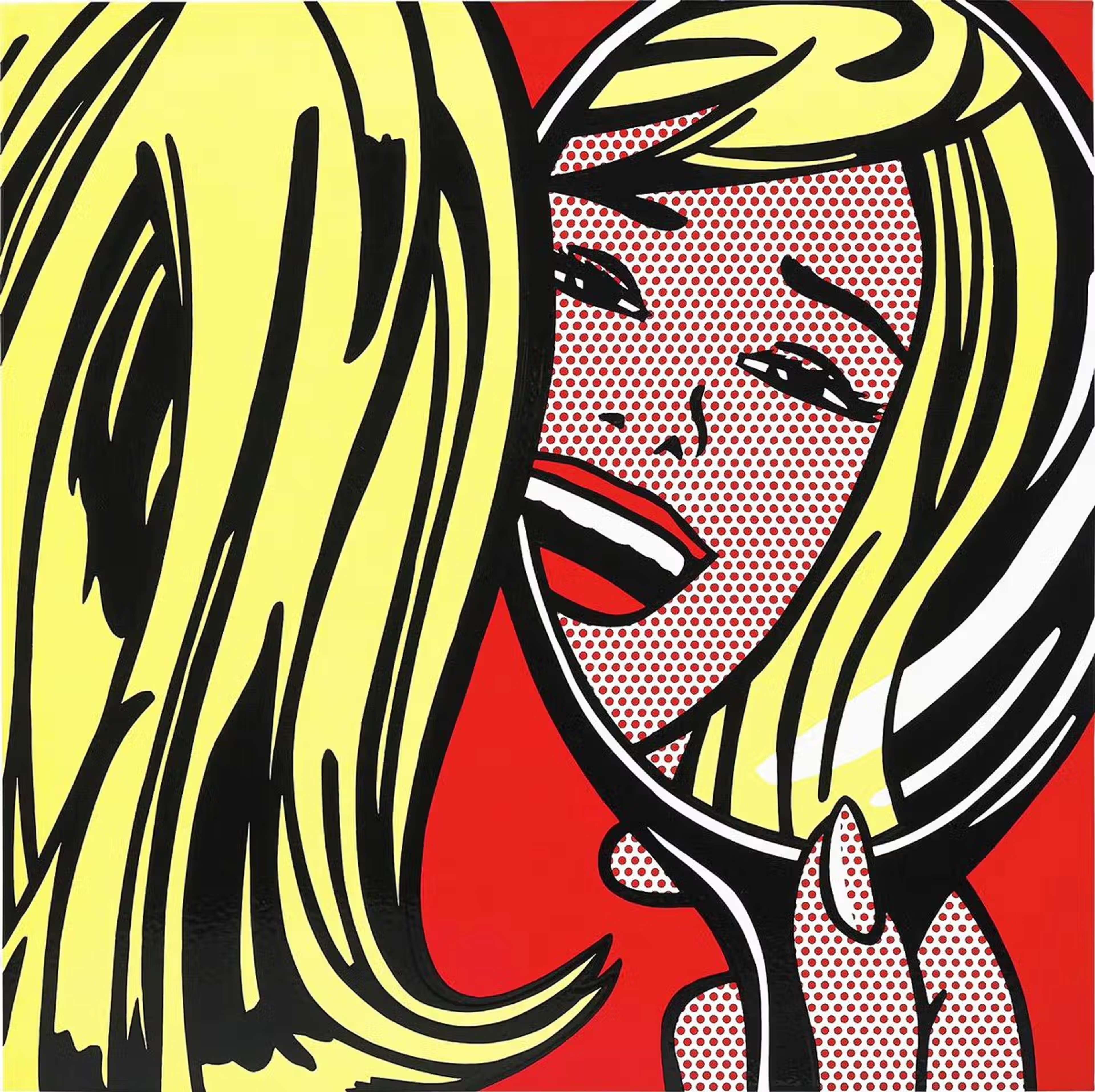
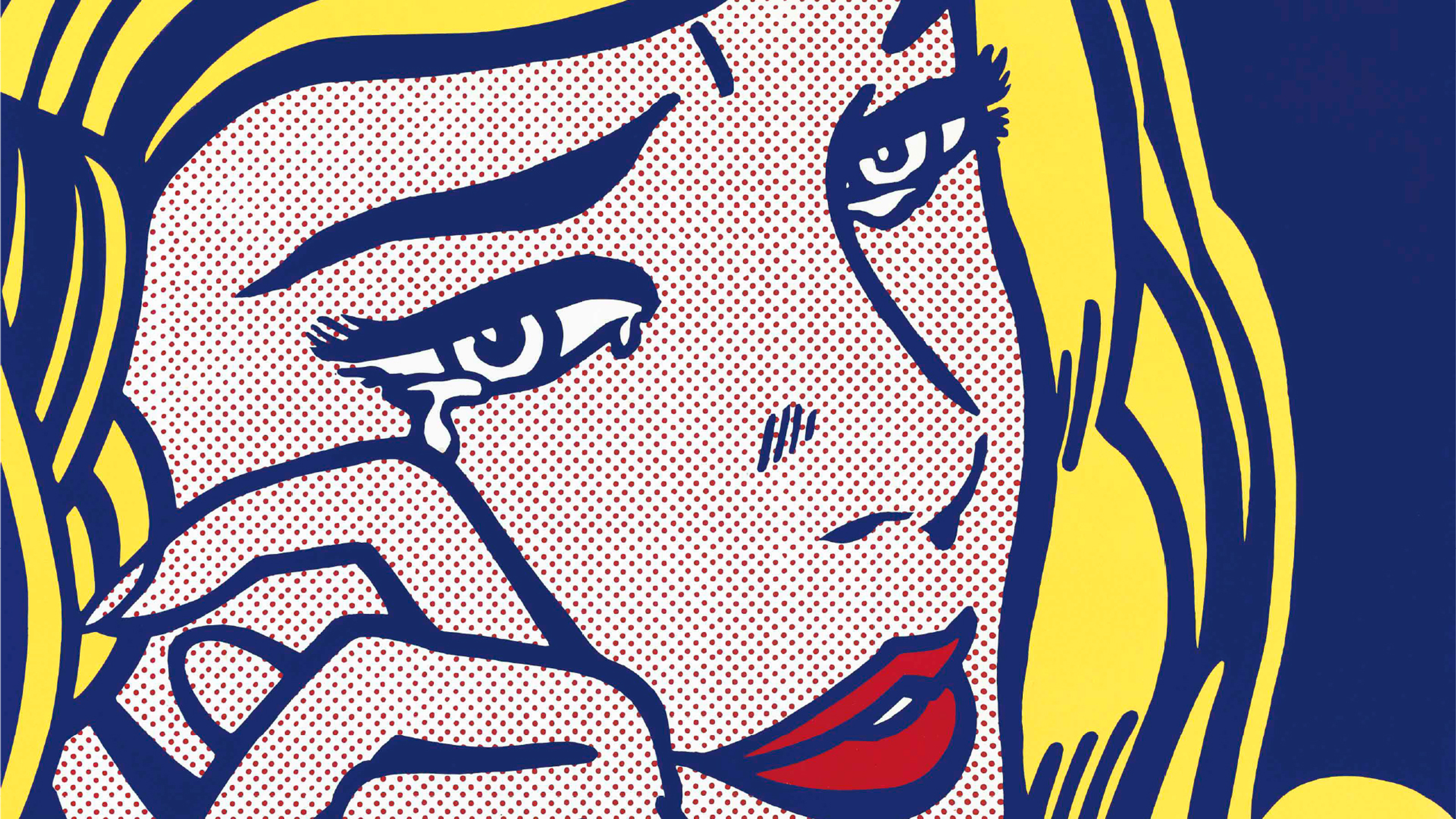
This bracket includes many of Lichtenstein's best-known images. Iconic Pop prints such as Crying Girl, Sweet Dreams Baby!, I Love Liberty and selected Interiors frequently trade within this range, offering collectors the opportunity to acquire some of the artist's most recognisable works without entering the market's highest price levels. Values vary considerably depending on the individual print, with impressions in excellent condition often achieving higher prices.
£90,000–£500,000+ Roy Lichtenstein Prints
Above £90,000, buyers begin to encounter the collections that have driven much of Lichtenstein's recent auction growth. Important works from the Nudes, Water Lilies, Reflections and early Pop series regularly achieve six-figure results, with values influenced by the individual image, edition structure, impression type and provenance. At this level, impression type becomes increasingly important, particularly within the Nudes and Water Lilies, where rare proofs and State I impressions have achieved significant premiums over standard editions.
£1 million+ Roy Lichtenstein Prints
The highest tier of Lichtenstein's print market is reserved for rare works with infrequent auction appearances. Lichtenstein's 1960s porcelain enamel-on-steel editions belong to this segment. The most recent example, Girl in Mirror (1964), returned to auction at Sotheby's in May 2026, achieving £4.6 million ($6.2 million USD).
Seven-figure results are no longer confined to Lichtenstein's earliest editions. The Water Lilies series has established itself as one of the strongest-performing areas of his print market, with multiple works now surpassing the million-dollar mark. Water Lily Pond With Reflections has consistently achieved seven-figure prices, while Water Lilies With Cloud became the latest work in the series to do so in May 2026, realising £768,077 ($1,024,000 USD). Together with million-dollar results from the Nudes, these sales demonstrate how the highest end of Lichtenstein's print market has expanded beyond his iconic Pop imagery to encompass some of his most technically ambitious later works.
What Determines the Value of a Roy Lichtenstein Print?
No two Lichtenstein prints are valued in exactly the same way. Buyers should assess several factors before comparing prices including the individual image, collection, rarity, impression type, condition and provenance.
How Collection Affects Roy Lichtenstein Print Value
One of the biggest influences on value is the collection a print belongs to. Certain bodies of work – including Water Lilies, Nudes and Reflections – have consistently attracted the strongest collector demand and highest average prices, while later abstract and architectural series generally offer more accessible entry points. Comparing auction results is therefore most meaningful within the same collection rather than across different parts of Lichtenstein's print market.
How Edition Structure and Artist Proofs Affect Roy Lichtenstein Print Value
Edition structure can have a significant impact on value. Most Lichtenstein prints are signed and numbered, although some impressions –particularly those published by the Leo Castelli Gallery – were issued signed but unnumbered and remain entirely legitimate editions.
Many prints also exist as artist's proofs (APs), printer's proofs (PPs) or in multiple states. In the strongest collections, rarer impression types can command substantial premiums over standard editions. However, proof designation alone does not determine value. The desirability of the individual image remains an important factor alongside rarity and impression type.
How Rarity Affects Roy Lichtenstein Print Prices
Edition size is only one measure of rarity. Equally important is how often a print appears on the market. Some editions surface regularly, allowing collectors to compare prices across multiple sales, while others may only appear publicly every few years. When exceptional works become available after long absences, competition can be significantly stronger, particularly for highly sought-after images.
Is Now A Good Time to Buy Roy Lichtenstein Prints?
The strength of Lichtenstein's print market is reflected in recent auction performance. Public sales reached approximately £15.9 million at the hammer across 350 lots in 2025 – the highest annual sales value and transaction volume of the past five years. Growth was not confined to a handful of trophy results. Transaction activity increased across much of the market, while the strongest expansion in value occurred at the higher price tiers.
Momentum has continued into 2026. At the April New York sales, Crak!, achieved £35,853 ($48,640) against a high estimate of $25,000, while Explosion more than doubled its high estimate to realise £61,329 ($83,200). Estate works also continued to perform strongly, with Bull VII selling for £70,735 ($96,000) against a $20,000–30,000 estimate and Nude in the Woods (Black State) reaching £47,156 ($64,000) against a $12,000–18,000 estimate. Together, these results suggest that demand remains resilient across both premium and more accessible segments of the market.
For buyers, that means understanding Lichtenstein's market is no longer simply about choosing the artist – it is about choosing the right work. Water Lilies, Nudes and Reflections have emerged as the strongest-performing areas of the market, but for very different reasons. Water Lilies has undergone a dramatic re-rating, the Nudes have developed increasingly visible premiums for rare impression types, while Reflections has built its position through sustained liquidity and comparatively stable pricing.
That does not mean other collections should be overlooked. Lichtenstein's exceptionally broad body of printed editions offers entry points across a wide range of price levels, from iconic 1960s Pop images to later abstract and landscape series. The advantage for buyers is choice: collectors can acquire works that align with their budget while still participating in one of the most established markets in Post-War printmaking.
How To Choose The Right Roy Lichtenstein Print For Your Collection
Lichtenstein's print market offers one of the broadest collecting landscapes in Post-War printmaking. Rather than asking which series is “best,” buyers should first consider what they want their collection to achieve. Some collectors prioritise art-historical significance, others seek the artist's most iconic imagery, while many focus on long-term market strength or building a coherent thematic collection.
For collectors interested in the strongest established areas, Water Lilies, Nudes and Reflections occupy particularly important positions within Lichtenstein's print market. Together, they generate a disproportionate share of auction value despite accounting for a relatively small proportion of works sold. However, each has developed differently. Water Lilies has undergone a significant re-rating, the Nudes have become increasingly differentiated by impression type, while Reflections has built its position through consistent trading activity and relatively stable pricing.
Within those collections, Water Lilies and the Nudes also show the greatest distinction between standard editions and rarer impression types, such as APs and State I impressions. Reflections, by contrast, offers a more liquid market with regular trading opportunities and less pronounced premiums for rarer variants.
Buyers drawn to Lichtenstein's dialogue with art history may prefer series such as Modern Art, Haystacks or his Surrealist prints. These works reinterpret artists including Picasso, Monet and the Surrealists through Lichtenstein's distinctive visual language, appealing to collectors building broader collections that span twentieth-century art movements.
Others are attracted to the artist's exploration of process and seriality. Complete portfolios such as Bull Profile Series offer the opportunity to collect an entire conceptual sequence rather than a single image, while landscape-based series including Moonscapes, Landscapes and Seascapes provide a quieter alternative to his better-known comic imagery, combining mechanical printing techniques with painterly references.
Budget should also influence the decision – but not necessarily limit it. While the highest prices are concentrated among the premium collections, Lichtenstein's extensive body of work provides entry points across a wide range of values. Many later series and less frequently discussed works remain comparatively accessible while still offering the technical sophistication and conceptual depth that define his printmaking.
Ultimately, the strongest acquisitions begin with a clear collecting objective. Whether you are drawn to iconic Pop imagery, art-historical reinterpretation, complete portfolios or technically ambitious printmaking, understanding how different collections function within Lichtenstein's market will help you make a more informed and rewarding acquisition.
Most Valuable Roy Lichtenstein Prints
Lichtenstein's most valuable prints share several characteristics. They typically belong to the artist's strongest-performing collections, are among the rarest impressions within those series, and appear infrequently at auction. At the premium end of Lichtenstein's editioned market, Water Lilies and the Nudes dominate. Since 2017, 27 of the 33 works to achieve hammer prices above £250,000 have come from these two collections alone.
- Water Lily Pond With Reflections – One of the defining works in Lichtenstein's print market, Water Lily Pond With Reflections became the first individual Lichtenstein print to achieve more than $1 million at auction. Despite the release of an Estate example in 2024, the collection's auction record remains with a non-Estate impression, which realised approximately $1.8 million (with fees) in 2023. The result demonstrates that demand for the collection's strongest images was firmly established before the Estate entered the market.
- Nude With Yellow Pillow (AP) – Among the most celebrated works from the Nudes series, the AP of Nude With Yellow Pillow achieved a hammer price of £793,570 ($1,000,000 USD) during Sotheby's November 2024 sale. The result reflected intense competition for one of the collection's rarest impressions and established a new benchmark for the image.
- Roommates (AP) – Roommates reached the same £793,570 ($1,000,000 USD) hammer price as Nude With Yellow Pillow during the same Sotheby's sale, despite a different edition structure. The result illustrates that rarity alone does not determine value. Collectors continue to place considerable weight on the desirability of the underlying image alongside impression type and scarcity.
While these works represent the highest end of Lichtenstein's market, they should not be viewed as the only desirable acquisitions. Many collectors instead focus on identifying exceptional examples within their preferred collection, where image, rarity, condition, provenance and impression type often have a greater influence on long-term desirability than headline auction records alone.
How Do You Authenticate a Roy Lichtenstein Print?
Authenticating a Lichtenstein print begins with confirming that it is an authorised edition documented in the Mary Lee Corlett Catalogue Raisonné of Prints. Buyers should then verify that the print's medium, dimensions, edition size, publisher and inscriptions all correspond with the published catalogue entry. Because Lichtenstein's market includes signed, unsigned, numbered and unnumbered editions, understanding what is normal for a specific print is essential before assessing authenticity or value.
Signed vs Unnumbered Roy Lichtenstein prints
Most Lichtenstein prints are signed in pencil and numbered from a stated edition. However, some authorised editions – particularly those published by the Leo Castelli Gallery – were issued signed but unnumbered. These are legitimate editions, not incomplete or later impressions.
An absent edition number is therefore not a warning sign in itself. What matters is whether the print matches the documented catalogue entry. Buyers should always verify that the signature, inscriptions and edition characteristics correspond with the relevant Corlett catalogue reference before drawing conclusions about authenticity.
Are Unsigned Roy Lichtenstein Prints Authentic?
Unsigned Lichtenstein works do exist, but buyers should approach them carefully. In most cases, unsigned works on the market are exhibition posters, open-edition reproductions or later commercial prints rather than limited editions.
That does not automatically make them inauthentic – they may still be original exhibition material – but they belong to a very different market from Lichtenstein's authorised editioned prints. If an unsigned work is represented as a limited edition, buyers should confirm that it appears in the Corlett Catalogue Raisonné before considering a purchase.
How Do You Check the Condition of a Roy Lichtenstein Print?
Condition is one of the most important value drivers in Lichtenstein's print market. Because his work relies on precision, flat colour, and sharply defined Ben-Day dots, even minor flaws can be visually pronounced and materially affect price.
How to assess condition in enamel-on-steel Lichtenstein works
Lichtenstein's porcelain enamel-on-steel editions require particular scrutiny. Buyers should inspect the surface carefully for chips, cracks, edge damage or areas where the enamel has begun to lift. Unlike paper-based prints, damage to the enamel surface is often impossible to restore invisibly, making overall surface integrity one of the most important considerations when assessing value.
How to check for trimming, restoration, and paper damage in screenprints
Early screenprints should be examined for trimming, restoration and paper condition. Many were issued with full margins, so cropped sheets can significantly reduce desirability and value. Buyers should also look for foxing, staining, hinge remnants, abrasions and evidence of excessive cleaning or restoration. Even well-executed conservation should always be disclosed and considered alongside the work's overall condition.
Colour integrity and surface quality in Lichtenstein prints
Lichtenstein's compositions depend on crisp Ben-Day dots, sharp linework and flat, saturated colour. Fading, uneven tonality or surface abrasion can noticeably alter the appearance of the image and affect value. Whenever possible, buyers should examine high-resolution images or inspect the print in person under natural or raking light to assess colour consistency and surface quality.
Framing history and long-term preservation
Framing history can reveal a great deal about how a print has been cared for. Buyers should ask whether the work has been archivally framed using acid-free materials and UV-protective glazing, or stored flat in appropriate conditions. Poor framing can lead to fading, paper discolouration, staining and adhesive damage over time. Well-preserved impressions consistently command stronger prices and are generally easier to resell.
Where to Buy a Roy Lichtenstein Print in 2026
Lichtenstein prints are available through major auction houses, regional auctions, private dealers, and specialist brokerage platforms. The right buying route depends on the series, condition sensitivity, and how competitive the specific work is likely to be.
Buying Roy Lichtenstein Prints at Auction
The major auction houses – Christie's, Sotheby's, and Phillips – handle the strongest Lichtenstein results, particularly for high-demand works such as Nudes, early 1960s Pop prints, and rare enamel editions. Sotheby's holds the current auction record for a Lichtenstein print, set in 2019. Buyers benefit from visible pricing history and clear catalogue documentation, but buyer's premiums of 25% or more add significantly to the purchase price. In competitive categories, strong examples rarely sell at a discount. Regional and specialist print auction houses can offer more accessible price points for mid-tier series.
Buying Roy Lichtenstein Prints Via Private Sale
Private sale offers discretion, negotiation flexibility, and access to works that may never reach public auction. In Lichtenstein's market – where complete sets are rare and certain states surface infrequently – private sourcing can be particularly effective. Private transactions also allow for deeper due diligence before commitment. Buyers can review condition reports, request additional imaging, and negotiate pricing without the time pressure of a live sale. For collectors targeting specific series or higher-condition impressions, private sale often provides a more controlled acquisition route.
Why Use MyArtBroker to Buy Roy Lichtenstein Prints?
Buying aLichtenstein print requires more than tracking auction results. His market is structured by medium, series hierarchy, edition nuance, and condition sensitivity – and pricing can vary significantly across venues. MyArtBroker provides buyers with both access and analytical context before committing capital. Our Trading Floor connects buyers directly with a global network of collectors, providing access to private inventory that may never appear at public auction. Our Instant Valuation tool benchmarks any specific work against recent comparable sales and series-specific performance data. And our specialist team reviews catalogue alignment, edition structure, condition, and provenance documentation before facilitating any transaction.

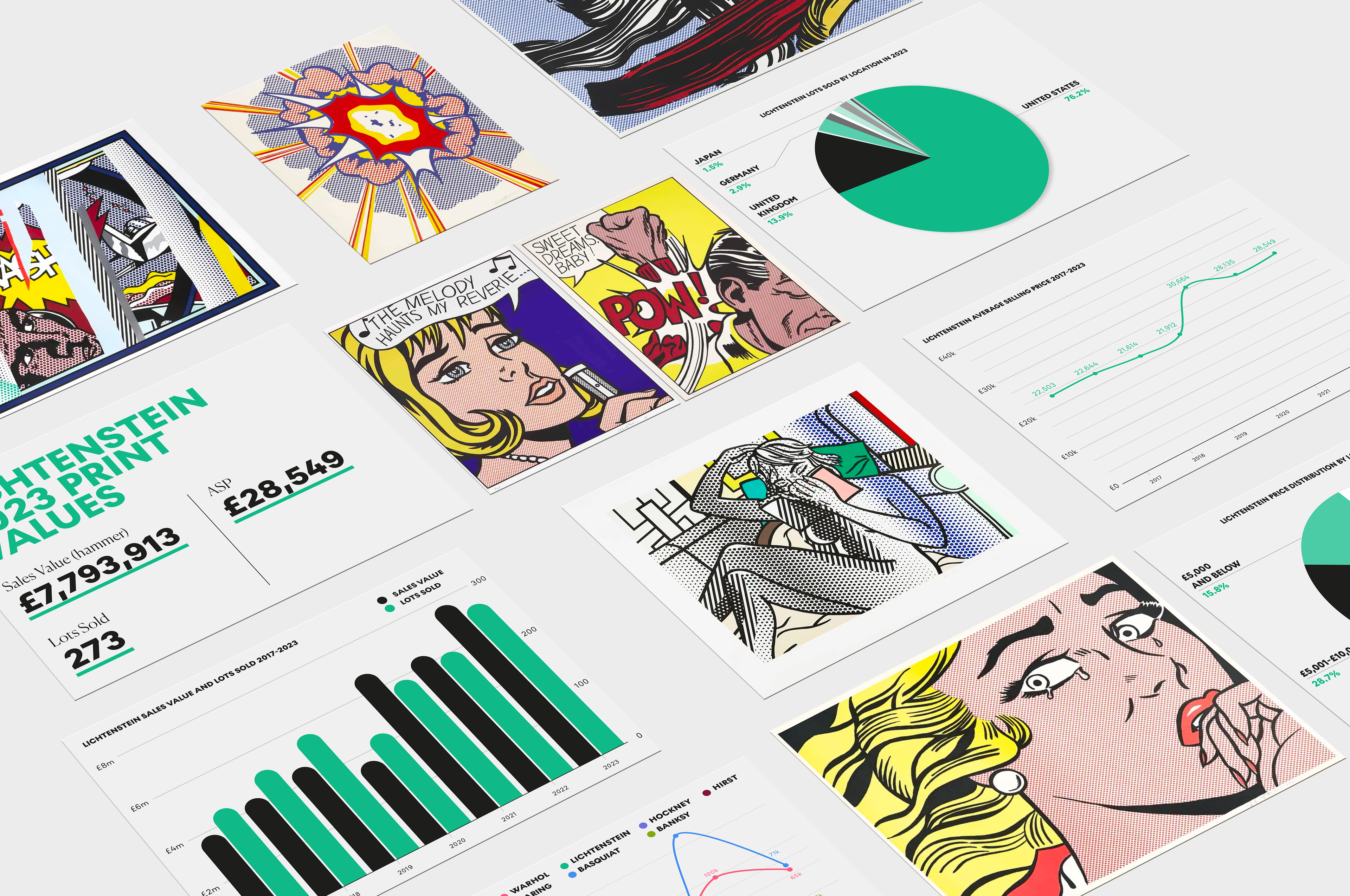
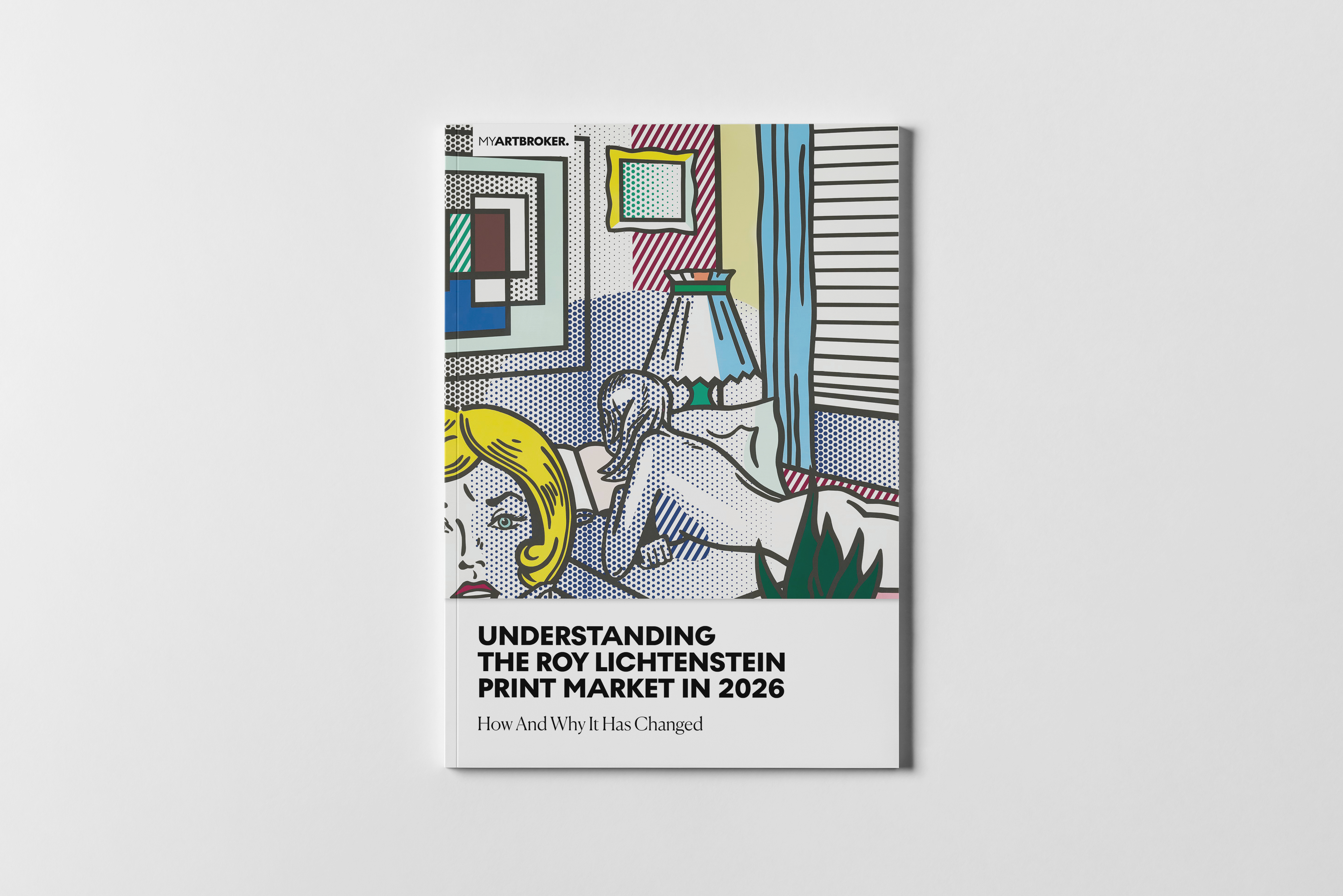
The Roy Lichtenstein Print Market Report 2026
How and Why the Market Has Changed: A 10-Year Analysis (2017–H1 2026)
This report analyses Roy Lichtenstein's print market over the past decade, examining auction performance, pricing trends, collector demand, the strongest-performing series, the growing premium for Artist's Proofs and the key developments shaping the market in H1 2026.