

Hockney’s Double Portrait Resurfaces in the Market
In November, Christie’s 20th Century Evening Sale in New York will present Hockney’s Christopher Isherwood and Don Bachardy (1968), the first of his canonical double portraits. For four decades the painting has been privately held, rarely leaving the care of a single collection except for landmark exhibitions. Most recently a centrepiece of David Hockney 25 at the Fondation Louis Vuitton in Paris, the work has also anchored major retrospectives at Tate Britain (travelling to the Centre Pompidou and The Met), in Hockney’s 1992 Brussels retrospective and at LACMA in 1988. Each showing has reinforced that this masterpiece was a turning point of Hockney’s career and a watershed for twentieth-century art.
So, who are the two sitters?
Christopher Isherwood
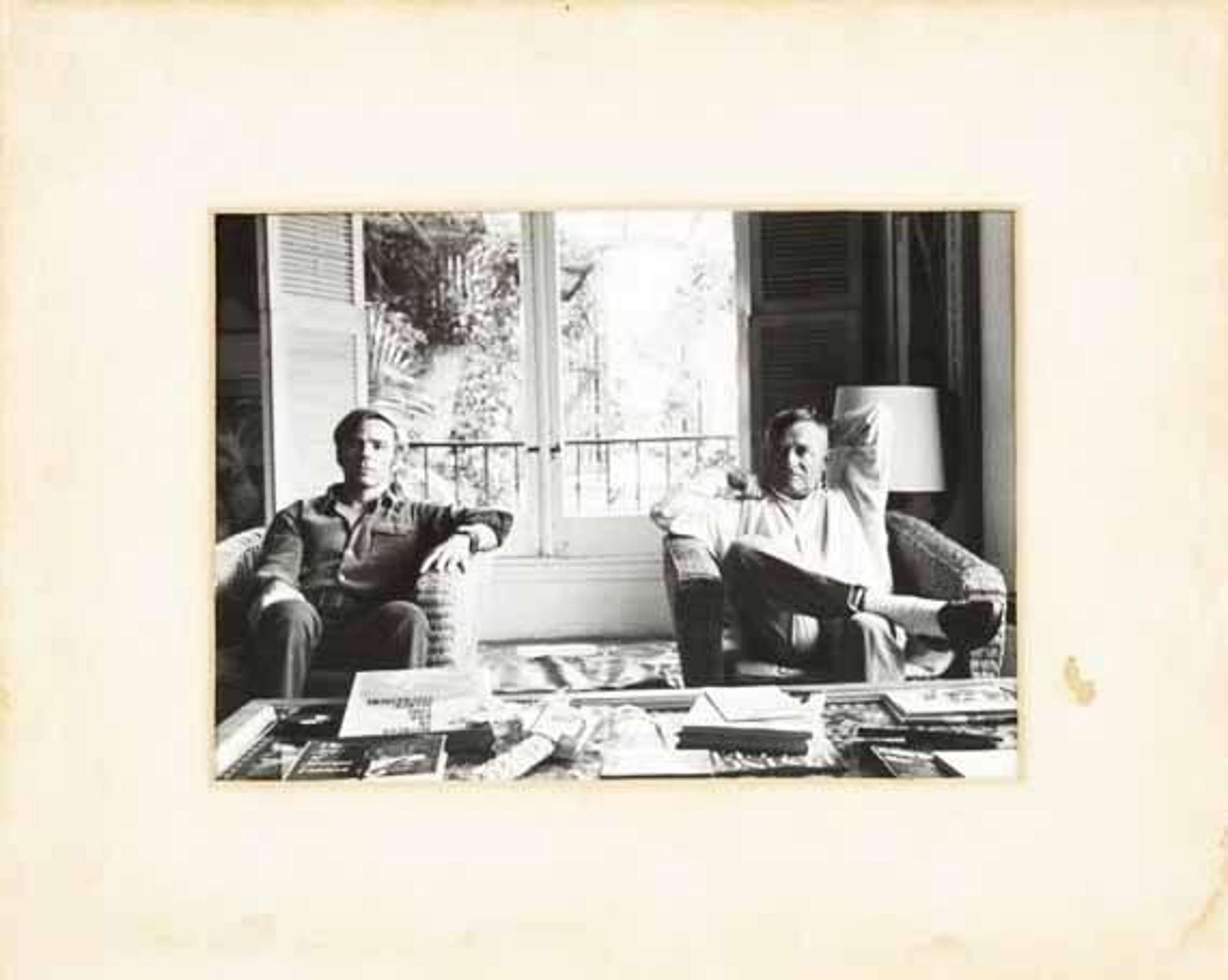
Christopher Isherwood (1904–86) was already a major literary figure when Hockney painted him. After early years in Weimar Berlin, he distilled an age of upheaval into the stories later collected as Goodbye to Berlin, the seedbed for Cabaret. In California he wrote A Single Man (1964), a novel about love, loss and the everyday performance of identity - a book that speaks to queer life with a directness that was shocking when it first appeared. By the late 1960s Isherwood had settled on the West Coast, welcoming writers, musicians and filmmakers to the Santa Monica house he shared with Bachardy.
Don Bachardy
Don Bachardy (b. 1934) arrived as Isherwood’s conspicuously younger lover, and later grew into a celebrated portrait artist. Encouraged relentlessly by Isherwood, Bachardy’s sitters have included Hollywood grandees and literary friends including Tennessee Williams, Elton John, Igor Stravinsky, Joan Didion and E.M. Forster. His drawings and paintings now reside in the collections of the Metropolitan Museum of Art, the Smithsonian and the National Portrait Gallery.
Isherwood and Bachardy’s creative traffic was constant: when distance intervened, the correspondence became a place to refine ideas, trade news, negotiate jealousies, and articulate the terms of their open arrangement with revealing frankness. Later collected as The Animals, these love letters between Isherwood and Bachardy reveal the tenderness, jealousy, pragmatism and humour that sustained them: pet names, doubts, the logistics of separations, and the ordinary domestic details that make a partnership real.
Hockney’s First Double Portrait
Hockney arrived in Los Angeles in 1964 and soon became a regular at the couple’s Santa Monica dinners. Their home functioned as a salon, and Hockney found in it the domestic stage he would soon translate into his first double portrait. Hockney’s Christopher Isherwood and Don Bachardy is the origin point of the style in which he perfected the triangulation between sitter, sitter and viewer.
In this work, the two sitters do not meet each other’s gaze; instead, their lines of sight and ours form a quiet geometry of connection and independence. Hockney’s objects serve the composition and the reading of the room. The paired stacks of books echo the duality of the sitters and point to a life organised around work and conversation. The placement of table, chairs and shutters is measured, allowing two distinct postures to coexist within a balanced domestic space.
Making the Ordinary Radical
Painted in 1968, the work falls between the partial decriminalisation of homosexuality in England and Wales (1967) and the Stonewall uprising (1969). The legal shift in Britain did not erase stigma, and in the United States social and professional risks remained acute. Against that backdrop, Hockney’s decision to stage Isherwood and Bachardy not as bohemians or coded allegories but as two men at home feels pointed. The picture declines melodrama and rhetoric, and instead uses domesticity to insist on the reality of a shared life. This ordinariness is not neutral; it strategically reframes visibility as a matter of everyday life rather than scandal, and it locates cultural significance in steadiness rather than transgression.
Why This Painting Matters Now
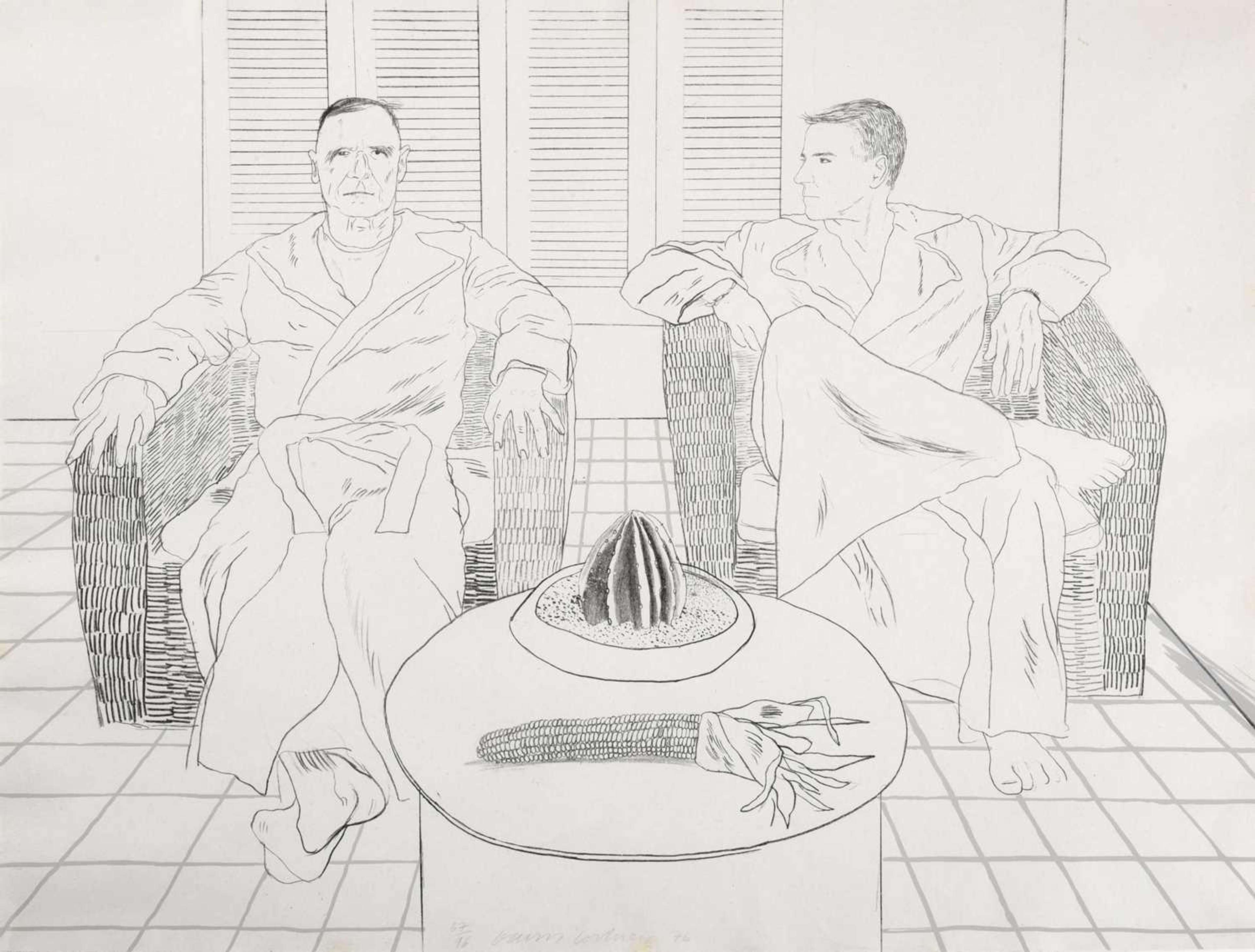
Christopher Isherwood and Don Bachardy (1968) was the first work in a series that would yield American Collectors (Fred and Marcia Weisman) (1968), Henry Geldzahler and Christopher Scott (1969), and Mr and Mrs Clark and Percy (1970-1). The work matters both as a candid modern image of a gay relationship at home and as a formally precise study in which geometry and perspective carry feeling. Hockney later returned to the image in print: a restrained study that translates the room’s architecture and the men’s presence into line alone.

What the Auction Might Hold
Christie’s has consigned Christopher Isherwood and Don Bachardy to the 20th Century Evening Sale in New York, with no estimate announced yet. Whether approached as a milestone in modern art, a player in LGBTQ+ history, or a tender document of two singular lives, the painting arrives at auction with biography, beauty, and historical meaning.