

Key Takeaways
How to Buy a Damien Hirst Print
- Understand the breadth of Hirst's market – his prints range from accessible individual works under £5,000 to complete sets reaching up to £80,000 at hammer, spanning spots, butterflies, skulls, cherry blossoms, and more.
- Prioritise series with capped editions – earlier releases with limited re-issuance (The Last Supper, Love Poems, pharmaceutical Spots) have retained stronger pricing discipline than heavily circulated HENI editions.
- Consider complete sets – portfolios traded as full sets consistently command premiums over the sum of their individual prints and provide stronger secondary-market confidence.
- Check authentication carefully – HENI editions do not come with a traditional certificate of authenticity; prints are hand-signed, numbered, and carry a HENI label on the reverse. Earlier works may carry COAs from original publishers or the defunct Hirst Authentication Committee.
- Buy through reputable channels – a surge of counterfeit Hirst prints entered the market in 2016, making provenance verification essential for any purchase.
Why Collect Damien Hirst Prints?
Hirst came to prominence in the late 1980s as part of the Young British Artists (YBAs), building his reputation through provocative installations – the shark in formaldehyde, the diamond-encrusted skull, the spot paintings – before expanding into printmaking in the late 1990s. His prints distil the themes of mortality, medicine, and consumer culture that run throughout his broader practice.
What makes Hirst's market appealing is its breadth. At one end, certain complete sets continue to achieve strong results at auction. At the other, individual works are widely available at accessible entry points, making him one of the most approachable blue chip artists for new collectors. His prolific output and sustained auction liquidity ensure a functioning secondary market with consistent price discovery – unlike scarcity-led markets where supply is unpredictable.
More than two decades on, Hirst's collaborations with HENI have kept his print practice active and relevant, introducing new series that expand his collector base while established works continue to circulate at auction globally.
What Types of Damien Hirst Prints Are Available?
Hirst's printmaking is as varied as his broader practice. Understanding the different formats, series, and production eras helps buyers assess what they are looking at and where it sits within his market.
Print Techniques and Formats
Hirst works across screenprint, woodcut, etching, giclée, and lithography. Many prints incorporate distinctive finishes – foil-blocking, diamond dust, or glitter – either across the full surface or applied selectively. Physical scale varies considerably: works from The Virtues and The Empresses measure around one metre square, while smaller projects like Love Poems are easier to place domestically. At the other end, works like New Religion (2005) take the form of large wallpaper panels.
Key Series and Collections
Hirst has produced both standalone editions and full portfolio sets. His major series include:
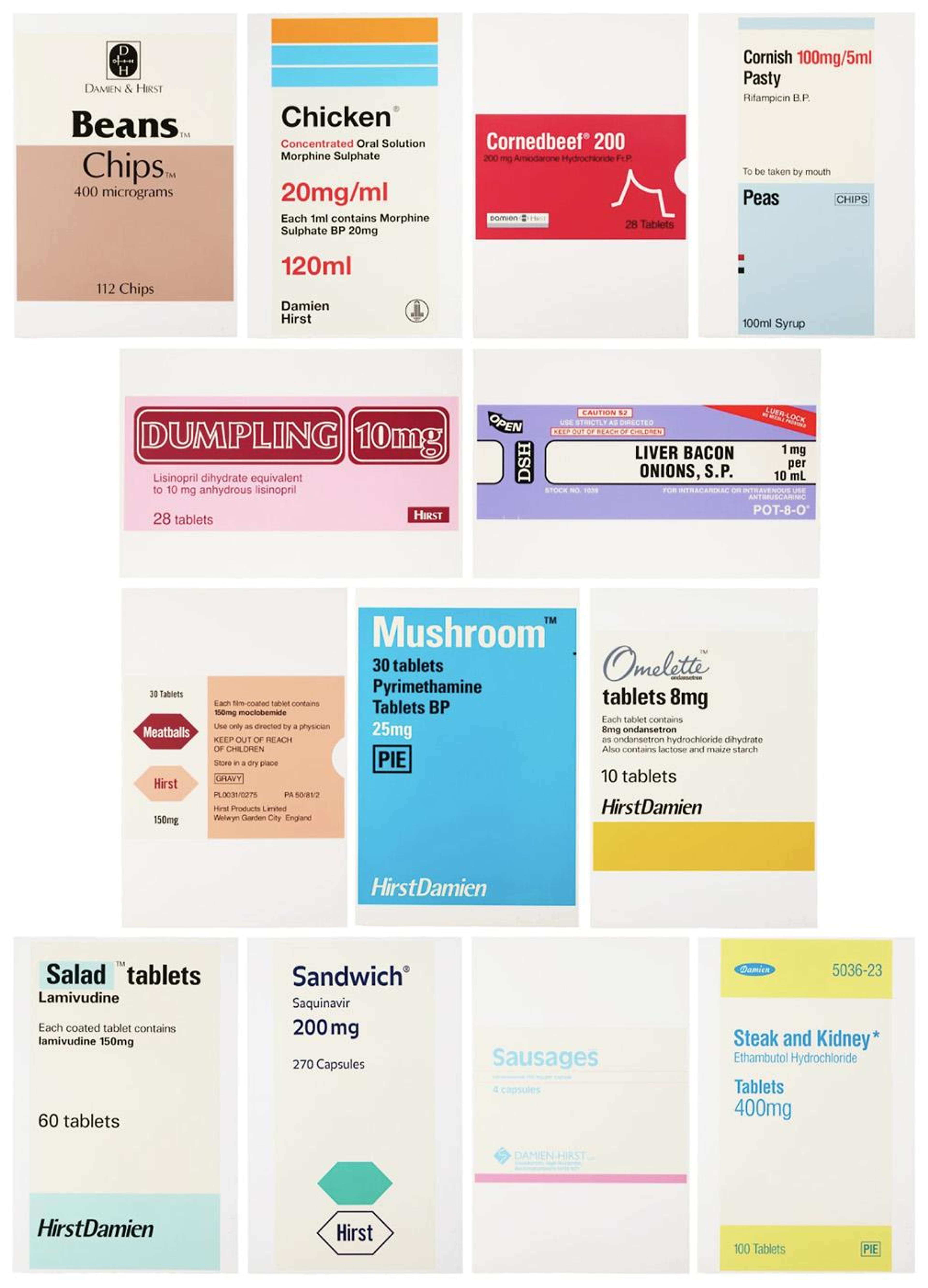
- The Last Supper (1999) – Hirst's debut print series. Screenprints reimagining pharmaceutical packaging with everyday food names. Editions of 150. Originally released as a complete set of 13; now more often encountered as individual sheets.
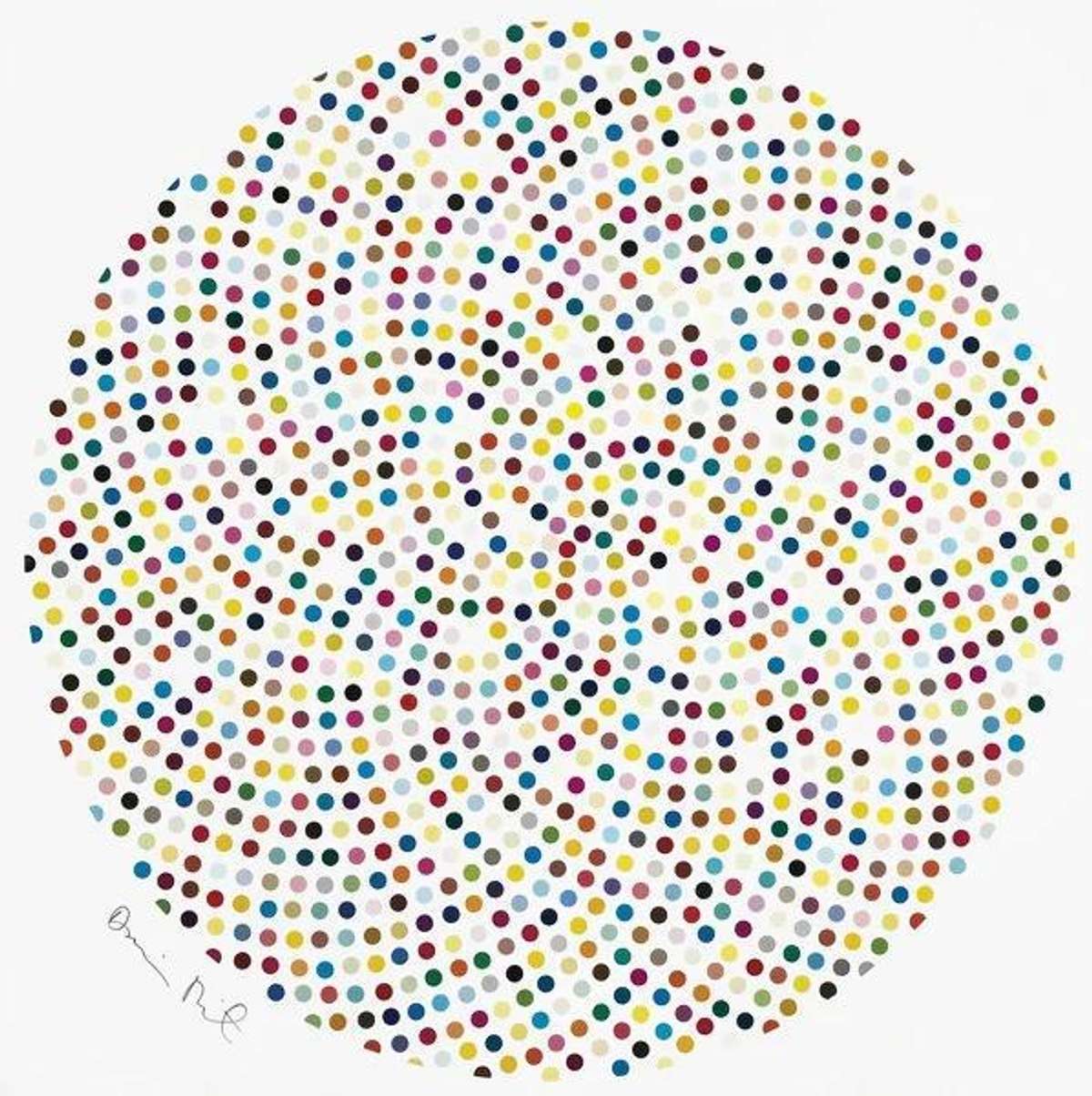
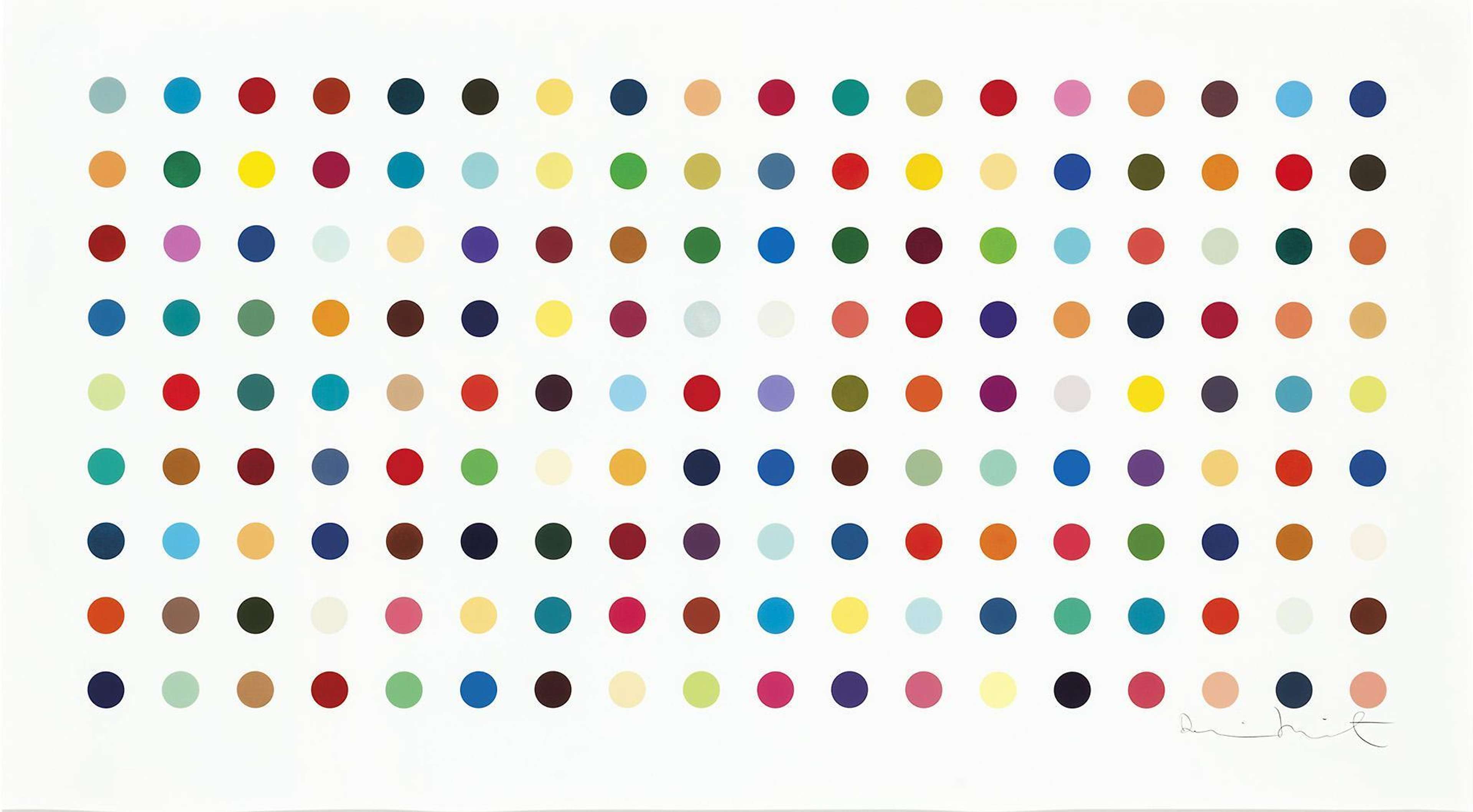
- Pharmaceutical Spots – His most prolific category, spanning multiple series and techniques (screenprint, woodcut, etching). Titles reference chemical compounds. Editions typically 50–150, produced across different publishers including Paul Stolper and Other Criteria.
- The Souls/The Souls on Jacob's Ladder – Butterfly-wing foil prints in various colourways. Editions vary.
- For the Love of God (2007) – Diamond skull motif. Screenprints with diamond dust and glitter.
- Love Poems – A compact portfolio of small-format prints. Circulated sparingly; complete sets are uncommon on the secondary market.
- 12 Woodcut Spots – Woodcut technique producing a rougher, more textured finish than the screenprinted Spots.
- Mickey Mouse – Collaborative/themed editions featuring the Disney character. Small editions.
HENI Editions (2019–present)
Hirst's ongoing collaboration with HENI has produced a significant volume of new work. HENI editions are identified by an H-number system and include:
- H4 Veils – abstract colour-field prints
- H5 Colour Space – geometric compositions
- H6 The Aspects/The Elements – 2019–2020
- H8 Fruitful & Forever – Cherry Blossom series, large open editions
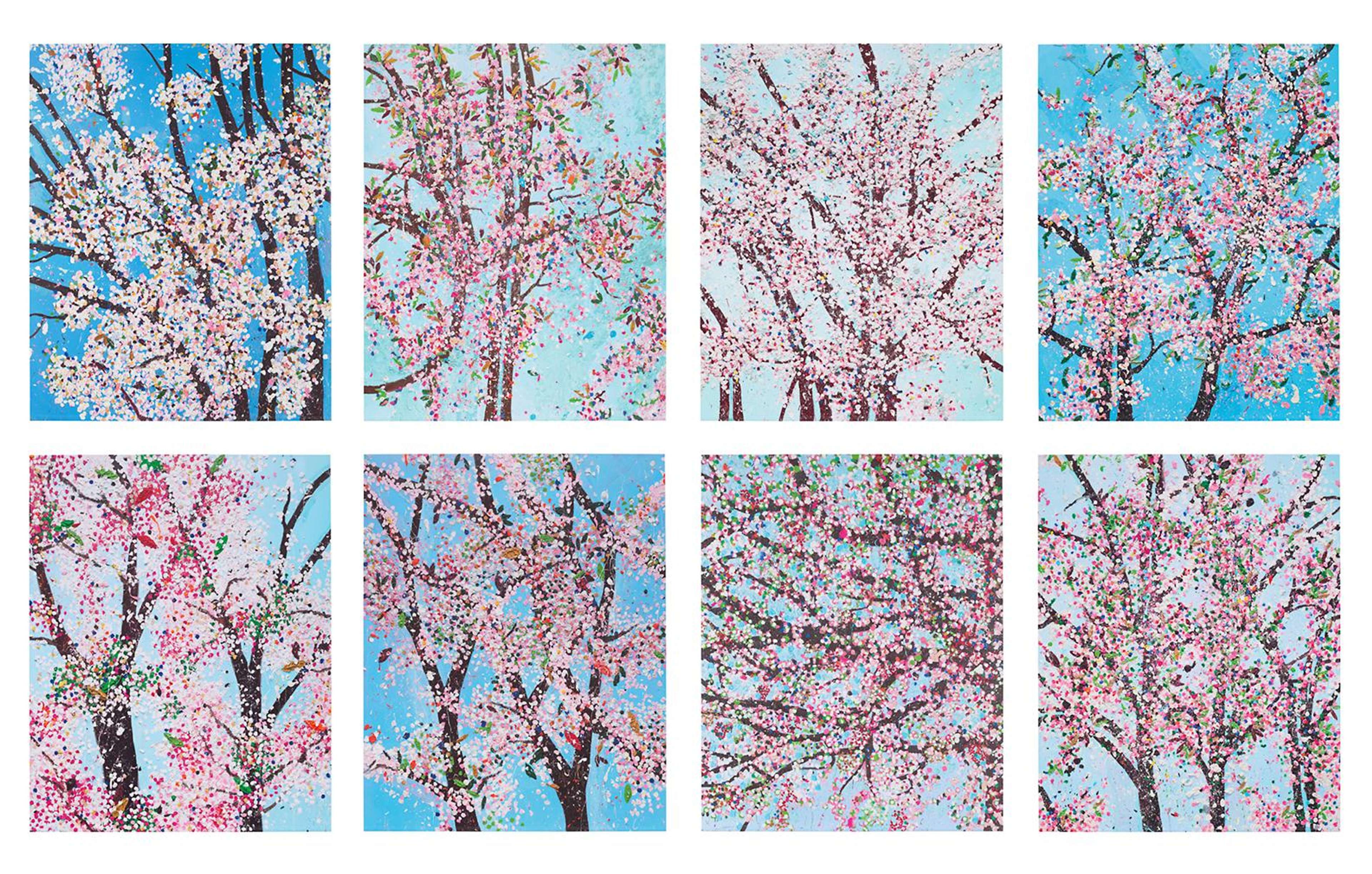
- H9 The Virtues – 2021, cherry blossom series, edition of 14 per print, set of 8
- H10 The Empresses – giclée on aluminium composite with glitter, butterfly kaleidoscope motif
- H11 The Currency – 10,000 unique dot paintings linked to NFTs
- H13 Where the Land Meets the Sea – 2023 seascape series
- H14 The Secrets – 2023
- H15 The Archangels – 2024, cherry blossom quadriptychs, editions of 100 plus 20 APs
- H17 Civilisation
- H18 Kaleidoscopes
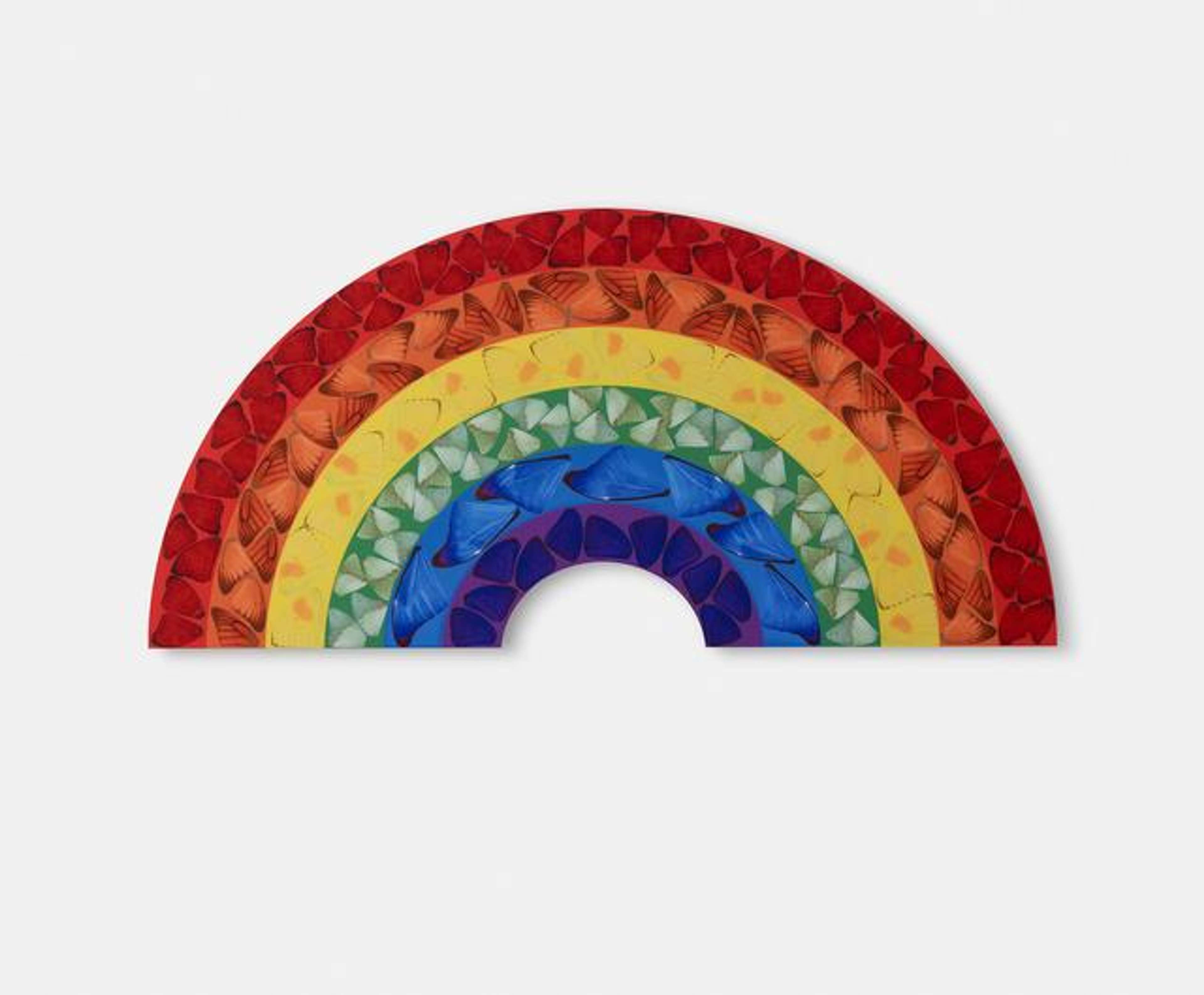
Edition sizes across HENI releases vary dramatically – from tightly limited suites like The Archangels (100 plus 20 APs) to large-scale open editions such as the Butterfly Rainbow prints, produced in the thousands. This range in scarcity is central to how collectors assess value and distinguishes which series are likely to perform on the secondary market.
How Much Are Damien Hirst Prints Worth in 2026?
Hirst's prints span a wide value spectrum, accommodating both new collectors and established buyers. The market's pricing structure reflects his prolific output – the majority of activity sits at accessible levels, with a smaller number of complete sets and rare editions anchoring the top end.
Price Distribution
Across 2024–2026, 416 lots traded below £5,000, accounting for £913,000 in total value. A further 261 lots traded between £5,000 and £15,000, generating £2.24 million – this is the most commercially significant bracket. Above that, 49 lots fell between £15,000 and £30,000 (£960,000 total), 11 lots between £30,000 and £50,000 (£401,000), and 11 lots above £50,000 (£722,000).
Complete Set Pricing
Complete sets represent the top of Hirst's print market. The Virtues (H9) is the benchmark: sets have traded between £60,000 and £100,000 in 2024–2026. Love Poems complete sets matched this level in 2024.
The Archangels (H15), a newer release, established its secondary-market level at £50,000 for a complete set.
Individual Print Pricing by Series
Pharmaceutical Spots are the most actively traded category in Hirst's market and show the widest price range. Tetrahydrocannabinol and Methamphetamine are some of the most sought-after titles, achieving anywhere from £30,000–£70,000. Most individual Spots fall between £3,000 and £20,000 depending on condition, size, technique, title, and colourway.
Individual Virtues prints trade regularly trade between £20,000–£40,000. The Empresses prints are more accessible, with individual works typically trading between £1,500 and £5,000. The Souls butterfly prints range from £2,000 to £10,000.
Market Trends and Volume
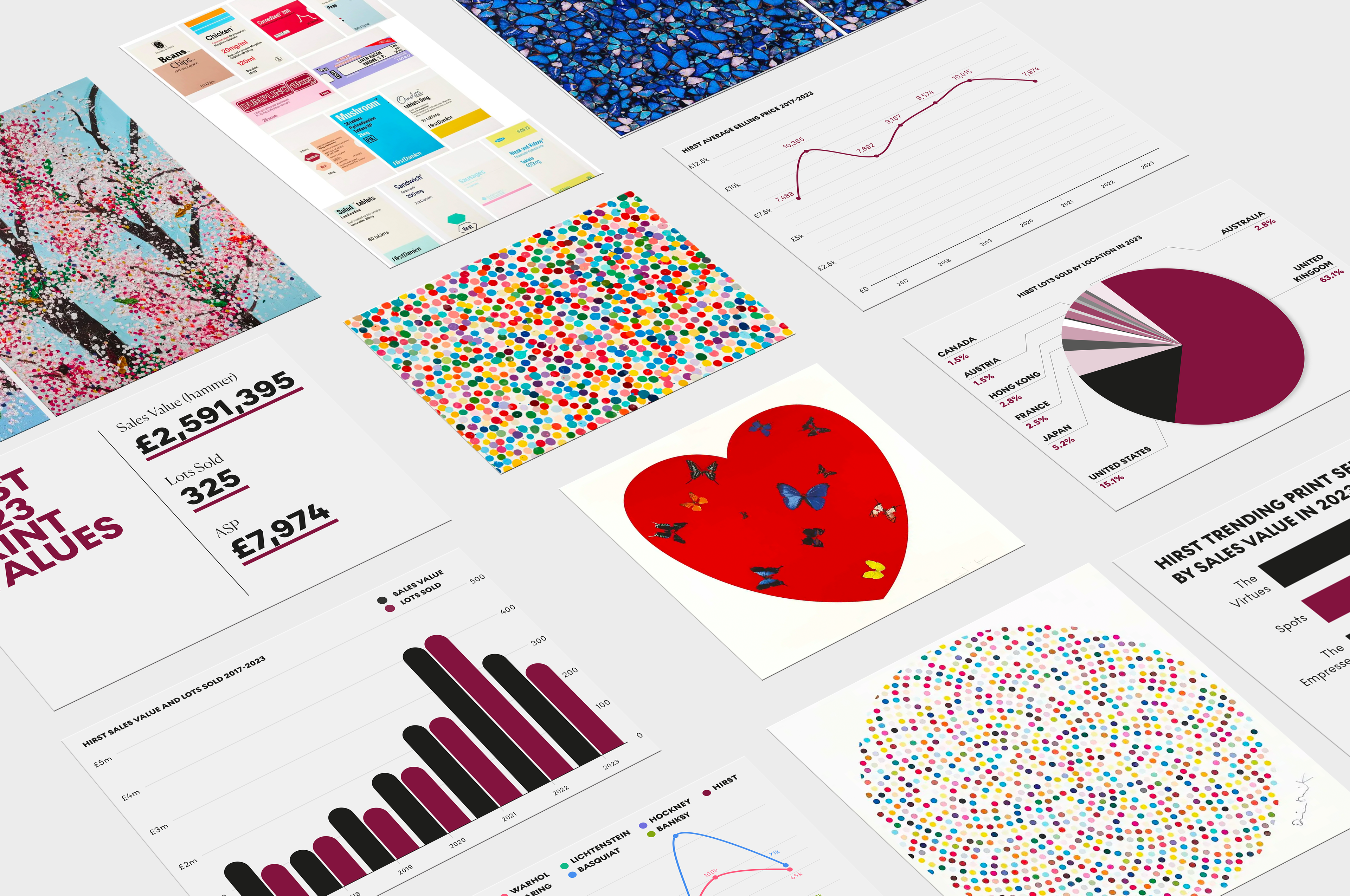
Hirst's print market peaked at £4.6 million in total sales in 2022. After contracting in 2023 and 2024, the market has stabilised: 2024 saw £2.5 million across 320 lots, 2025 generated £2.1 million from 356 lots, and 2026 through Q2 has already reached £663,000 from 72 lots.
Average selling prices declined from their 2022 peak (c. £9,600) to £5,800 in 2025 as the market absorbed a high volume of widely available HENI editions. In 2026 to date, the average has recovered to £9,200, driven by stronger results at the top end. Critically, transaction volume has remained robust throughout – this is a market defined by liquidity and consistent turnover rather than episodic scarcity.
Which Damien Hirst Prints Are Most In Demand?
Demand in Hirst's market is shaped by series identity, edition discipline, and format. The strongest-performing collections tend to represent completed ideas – where narrative, format, and issuance are finite.
Series to Watch
- The Archangels (H15) – The most tightly editioned recent HENI release (100 plus 20 APs). Already establishing secondary-market comparables, with complete sets trading at auction since 2024.
- Mickey Mouse – Small edition sizes and strong visual identity have driven disproportionate demand relative to availability – only 10 lots traded in 2024–2026 but with meaningful total value.
- Where the Land Meets the Sea (H13) – A newer series gaining traction, with 43 lots traded in 2024–2025. Worth monitoring as secondary-market depth develops.
- 12 Woodcut Spots – The woodcut technique produces a rougher, more distinctive finish than screenprinted Spots. Lower edition counts and collector preference for the handmade quality support demand.
As a general principle, series with contained edition sizes and a clear conceptual narrative tend to hold value more firmly than heavily circulated open editions. When weighing an individual print against a complete set, sets consistently provide stronger pricing authority on the secondary market.

How to Authenticate a Damien Hirst Print
Hirst's market is generally well regulated, but authentication remains essential – particularly given a documented surge of counterfeit Hirst prints in 2016. Verification requirements differ depending on when and how the print was produced.
HENI Editions (2019–present)
HENI editions do not come with a certificate of authenticity. Instead, prints are hand-signed by the artist, uniquely numbered, and carry a HENI label affixed to the reverse. Edition numbers are randomly allocated and cannot be chosen. HENI's customer support can confirm provenance for specific works. The exception is The Currency (H11), which uses blockchain technology on the Palm chain for digital provenance, and whose physical works include additional security features: a watermark, microdot, and hologram.
Pre-HENI Editions
Earlier prints may carry certificates from the now-defunct Hirst Authentication Committee, or documentation from original publishers such as Paul Stolper, Other Criteria, or Paragon Press. Gallery invoices, sale receipts, and prior auction records all contribute to provenance. In every case, buyers should request full documentation before purchasing.
What to Check
- Publisher documentation, HENI label, or COA (for pre-HENI works) matching the specific work.
- Consistent edition numbering, signatures, and publisher stamps or blindstamps.
- For foil-blocked or diamond-dust works, surface finish consistent with documented examples.
- Clear chain of ownership – be cautious of works with vague or undocumented provenance.
- For The Currency (H11) editions, verify the associated NFT record on the Palm blockchain alongside physical security features (watermark, microdot, hologram).
How to Assess the Condition of a Damien Hirst Print
Hirst's prints often feature delicate materials that require careful inspection. Foil-blocking, diamond dust, and glitter finishes are particularly susceptible to surface loss, fading, or damage from improper handling or framing.
Prospective buyers should request unframed, high-resolution images where possible to check for signs of fading, buckling, colour shifts, or surface loss – particularly along edges and in areas where dust or foil has been applied. Giclée prints on aluminium composite (such as The Empresses) should be checked for scratches or denting.
For screenprints and etchings, standard paper-based condition considerations apply: margin integrity, foxing, light damage, and any evidence of trimming or restoration. Prints that have been stored flat, away from direct light, in stable humidity conditions will present best. Professional framing with UV-protective glazing and acid-free mounting is recommended for long-term preservation.

When Is the Best Time to Buy a Damien Hirst Print?
Hirst's market operates differently to scarcity-led artists. Because supply is consistent and auction appearances are frequent, timing is less about waiting for a rare opportunity and more about reading the cycle.
The post-2022 correction created buying opportunities as prices adjusted from peak levels while transaction volume remained strong. For buyers entering the market now, the stabilised pricing environment – particularly in the £5,000–£15,000 bracket – offers a chance to acquire established works at a reset level.
New HENI releases also create entry points. Primary-market pricing for new series can represent value if the edition is tightly capped – The Archangels, for example, has already established secondary-market demand since its 2024 release. However, large open editions rarely appreciate on the secondary market, so edition size should be weighed carefully against release price.
For complete sets, monitoring auction calendars at Phillips, Christie's, and Bonhams – where Hirst portfolios appear regularly – helps identify acquisition windows when multiple sets are available and competition may be distributed.
Where to Buy Damien Hirst Prints
Collectors have several routes to acquiring Hirst prints, each with different cost structures and advantages.
Auction Houses
Phillips, Christie's, Bonhams, and Sotheby's regularly feature Hirst in prints and multiples sales, with Phillips offering dedicated Hirst-focused auctions. Auction provides price transparency and competitive validation, but buyer's premiums (typically 25% plus VAT) significantly increase the final cost above the hammer price, alongside shipping and taxes.
Private Dealers and Online Platforms
Specialist platforms such as MyArtBroker provide access to works not publicly listed at auction or on HENI, drawing from a network of private collectors. This route is particularly useful for sourcing specific titles, complete sets, or earlier editions that rarely appear at auction.
Why Use MyArtBroker to Buy a Damien Hirst Print?
MyArtBroker connects buyers with a dedicated specialist and a global network of over 40,000 collectors, dealers, and galleries. Our live Trading Floor provides access to Hirst prints available through private networks – including complete sets, early editions, and works that do not appear at public auction.
Every print sourced through our platform is checked for authenticity and condition by our specialist team. We handle the full transaction – sourcing, verification, and delivery – combining specialist reliability with online transparency. Our market reports, valuation tools, and data-driven insights help you buy at the right level for your collection.