
MyArtBroker took the question from the streets of London and asked the world as part of the largest global survey exploring the art we love, and most importantly, the reasons we love the works we do.
To little surprise, a handful of iconic names dominate the top of the list. However, the results reveal some fascinating insights into the cultural impact of art based on demographics like nationality, generation, and gender. UK respondents, for example, ranked Edward Hopper’s Nighthawks first, Paul Delaroche’s The Execution of Lady Jane Grey Second, and John William Waterhouse’s The Lady of Shalott third.
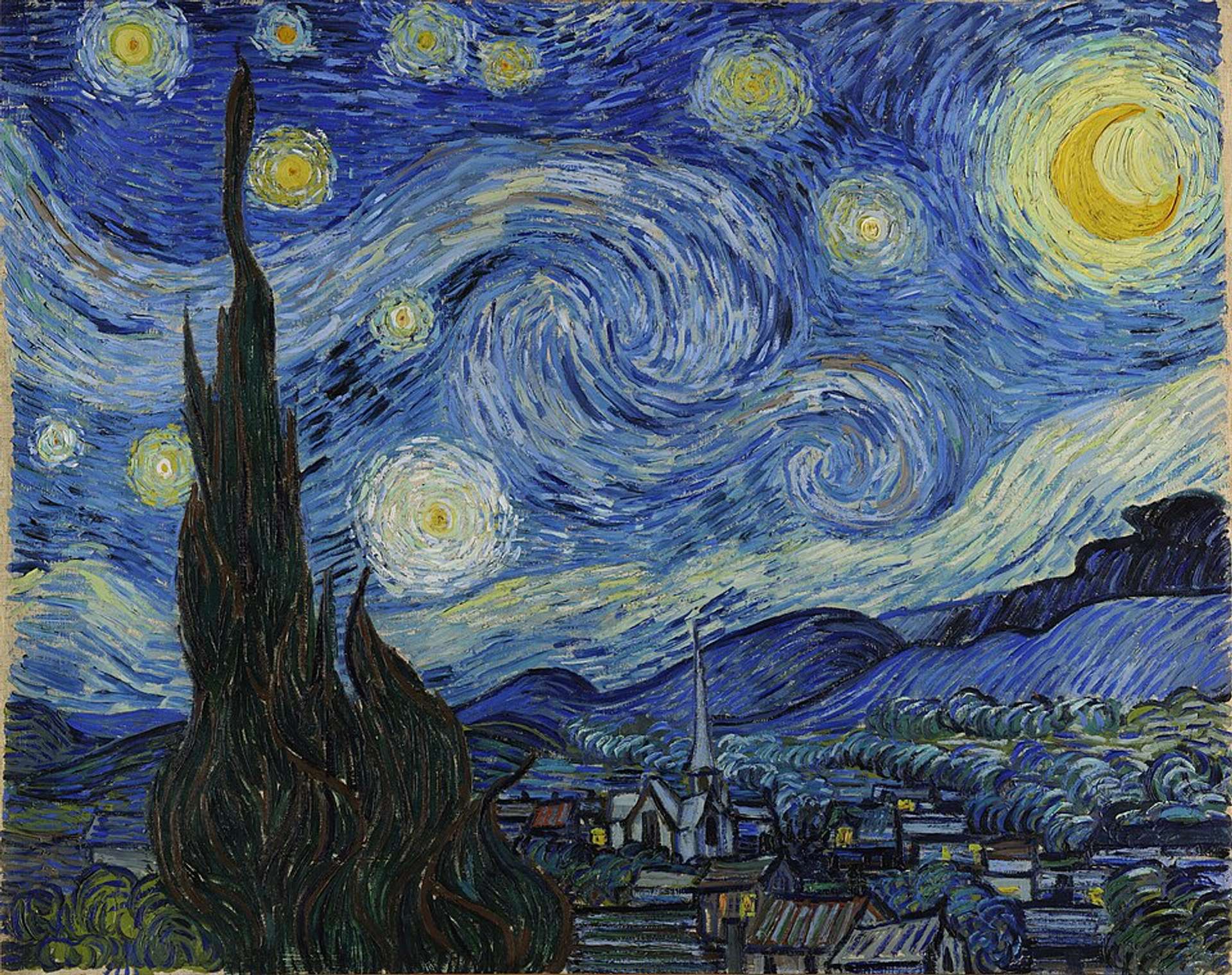
Of the 7,642 respondents, Van Gogh’s The Starry Night received 1.37% of the total global votes, highlighting the sheer breadth of answers received. Participants could enter any artist or artwork they desired in an open field, offering a truly diverse portrait of contemporary taste in art.
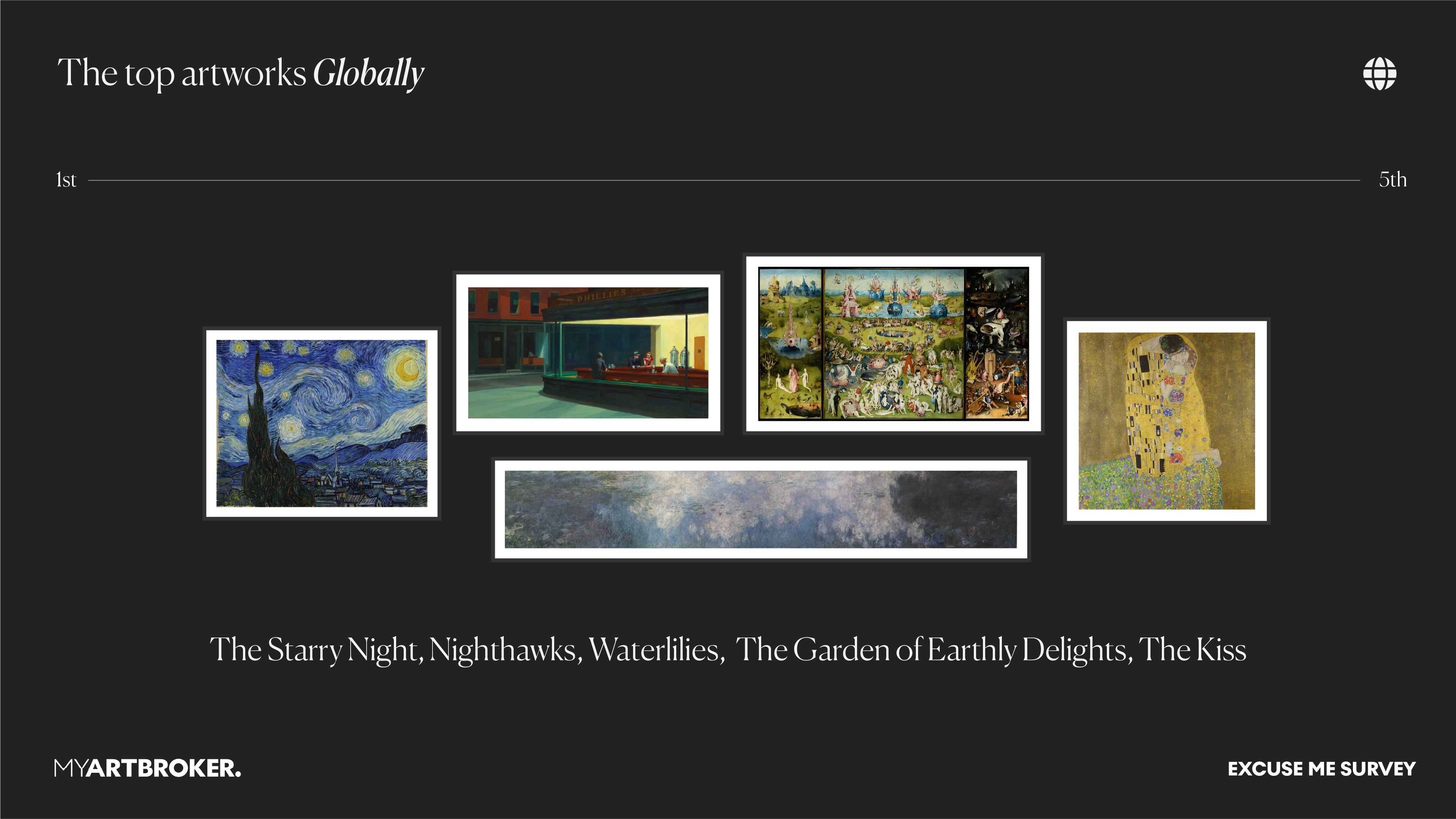
Top 5 Artworks Globally
| RANK | ARTWORK | ARTIST | NO. VOTES | % TOTAL RESPONSES |
|---|---|---|---|---|
| 1 | The Starry Night | Vincent Van Gogh | 105 | 1.37 |
| 2 | Nighthawks | Edward Hopper | 104 | 1.36 |
| 3 | Waterlilies | Claude Monet | 84 | 1.09 |
| 4 | The Garden of Earthly Delights | Hieronymus Bosch | 81 | 1.06 |
| 5 | The Kiss | Gustav Klimt | 76 | 0.99 |
Just 29 votes separate first from fifth place, and Van Gogh’s winning share is only 1.37% of all answers. Together, these top five account for less than 6% of responses, showing that there is no single work that dominates public taste to a notable extent. Spanning more than 400 years of artistic production – from Bosch’s late medieval triptych to Hopper’s 20th century painting of a diner – this shortlist hints at the wide range of works cited throughout the survey.
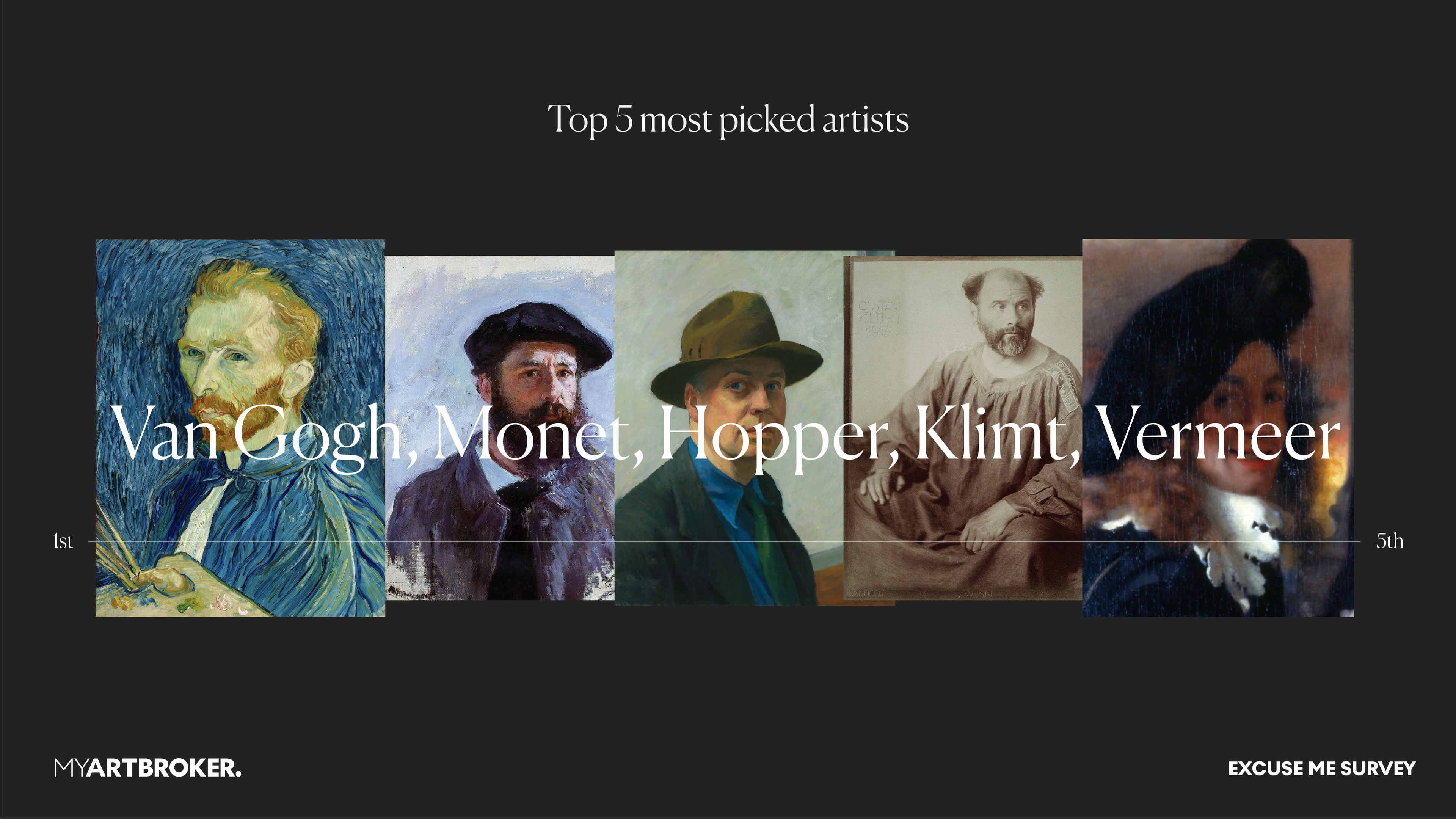
Top 20 Artists Globally
| RANK | ARTIST | RANK | ARTIST |
|---|---|---|---|
| 1 | Vincent Van Gogh (293 votes) | 11 | Mark Rothko (85 votes) |
| 2 | Claude Monet (248 votes) | 12 | Michelangelo Buonarroti (85 votes) |
| 3 | Edward Hopper (171 votes) | 13 | Sandro Botticelli (82 votes) |
| 4 | Gustav Klimt (168 votes) | 14 | Rembrandt Van Rijn (80 votes) |
| 5 | Johannes Vermeer (111 votes) | 15 | Francisco de Goya (77 votes) |
| 6 | Pablo Picasso (94 votes) | 16 | Caravaggio (76 votes) |
| 7 | Hieronymus Bosch (94 votes) | 17 | John Everett Millais (65 votes) |
| 8 | Rene Magritte (93 votes) | 18 | Caspar David Friedrich (63 votes) |
| 9 | Salvador Dalí (91 votes) | 19 | John William Waterhouse (59 votes) |
| 10 | John Singer Sargent (89 votes) | 20 | Jackson Pollock (58 votes) |
Van Gogh leads the top artists globally with 293 mentions (just under 4% of all responses), yet the entire Top 20 accounts for fewer than 30% of the 7,642 responses. The names span five centuries, from Michelangelo and Botticelli to Rothko and Pollock, and reflect the favourable position Western artists have held in the canon historically while remaining stylistically diverse. Every artist in this top 20 is either European or American, also reflecting the historic biases towards these regions – both in terms of artistic training, and institutional presence.
What the list does not show is equally revealing: every artist in the top 20 is male. You have to look to rank 21 to find the first woman artist, Remedios Varo, and just six women appear within the global top 50. Their scarcity is certainly not down to obscurity – Varo, Frida Kahlo, Yayoi Kusama, and Artemisia Gentileschi are widely recognised – but rather due to the long-term effects of historical exclusion from major collections, syllabuses, and auction house headlines. That trend doesn’t shift across generations either. After the Silent Generation (0% of whom selected a female artist), Baby Boomers were the generation that picked female artists the least, with just 6.13% of the cohort choosing a female artist. Baby Boomers were surpassed by Generation X (6.64%), Millennials (6.80%), and Generation Z (7.30%), who were the most likely to choose a woman artist.
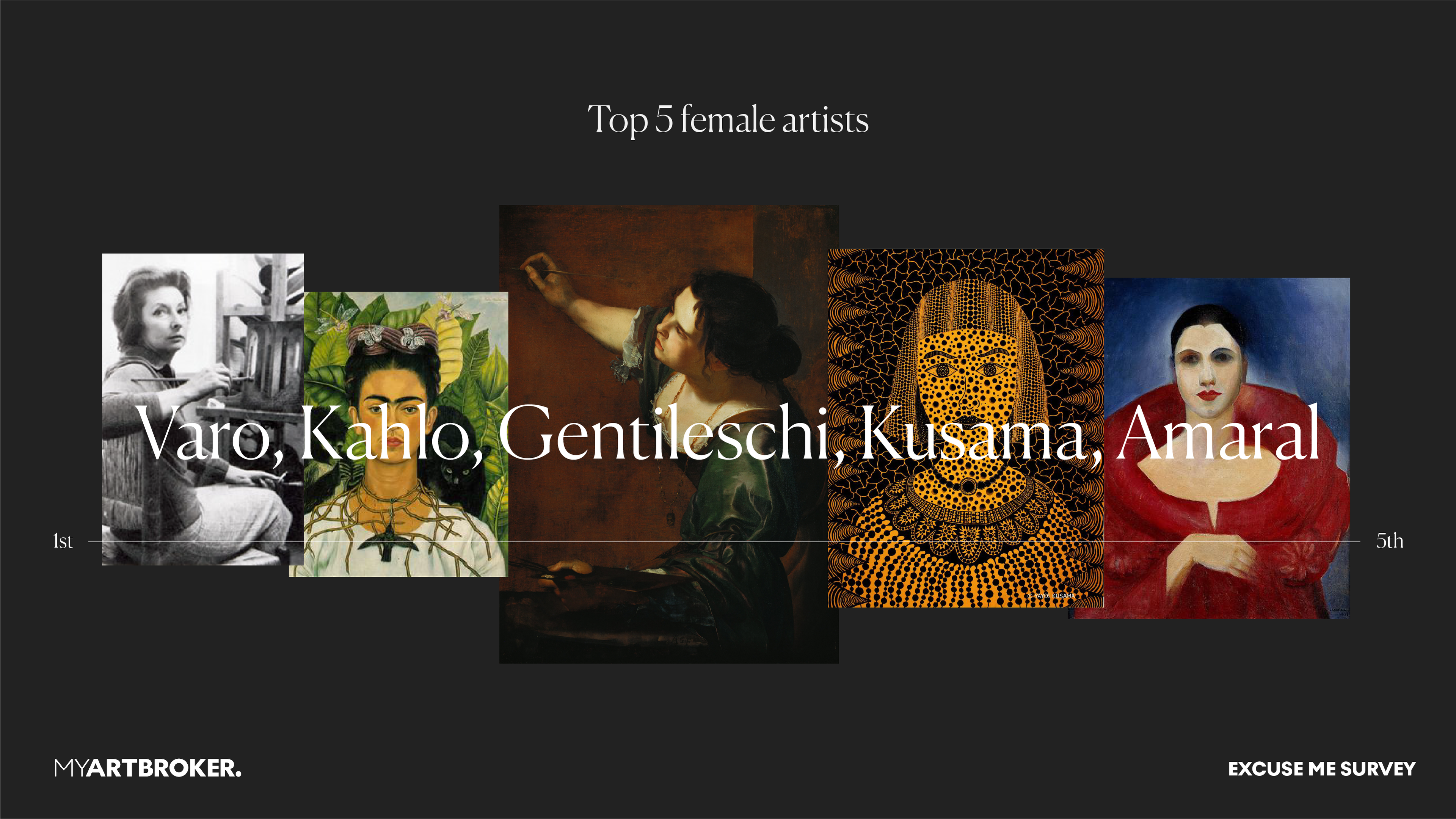
Top Female Artists Globally
These were the top women artists in the top 50 and their respective ranks:
- Remedios Varo (Rank 21)
- Frida Kahlo (Rank 24)
- Artemisia Gentileschi (Rank 38)
- Yayoi Kusama (Rank 41)
- Tarsila do Amaral (Rank 46)
- Hilma af Klint (Rank 47)
Only six women artists broke into the global top 50 artist ranking, a clear signal that the historical under-representation of female creators still shapes an unconscious bias towards male artists. Gender strongly influences the outcome: 8.3% of women respondents chose a female artist, versus 4.7% of men, while 6.7% of the relatively small group of non-binary participants chose female artists.
The United States delivers the largest raw tally of votes for women (101), with the United Kingdom next (81) and Brazil third (42). Canada, Italy, Germany and Australia each contribute double-digit counts, indicating that museum exposure and English-language media still amplify awareness globally. Yet even in these higher-volume markets, women receive fewer than one vote in ten – evidence that increased visibility has not yet closed the gap.
Top 20 Global Female Artists
| RANK | ARTIST | RANK | ARTIST |
|---|---|---|---|
| 21 | Remedios Varo | 117 | Tracey Emin |
| 24 | Frida Kahlo | 122 | Tamara de Lempicka |
| 38 | Artemisia Gentileschi | 125 | Barbara Hepworth |
| 41 | Yayoi Kusama | 127 | Paula Rego |
| 46 | Tarsila do Amaral | 156 | Berthe Morisot |
| 47 | Hilma af Klint | 173 | Dorothea Tanning |
| 66 | Louise Bourgeois | 178 | Emily Carr |
| 81 | Mary Cassatt | 191 | Helen Frankenthaler |
| 96 | Leonora Carrington | 192 | Bridget Riley |
| 116 | Camille Claudel | 203 | Helene Schjerfbeck |
Expanding to the top 20 women artists overall introduces voices from five continents and every era since the 1600s. The amount of votes for each of these women artists drops off after the most familiar names, showing that public reception for many of these artists is just starting to widen. Modern and contemporary women artists make up the majority, suggesting that recent exhibitions and scholarship are driving awareness. However, the steep fall-off in mentions underscores just how much work remains to champion a wider range of female creators.
Top 5 Artworks by Female Artists
| RANK | ARTWORK TITLE | ARTIST(S) |
|---|---|---|
| 1 | Judith Slaying Holofernes | Artemisia Gentileschi |
| 2 | Abaporu & Maman | Tarsila do Amaral & Louise Bourgeois |
| 3 | The Two Fridas & Infinity Mirror Room | Frida Kahlo & Yayoi Kusama |
| 4 | Woman Leaving the Psychoanalyst’s Office | Remedios Varo |
| 5 | The Ten Largest | Hilma af Klint |
The ten most-cited artworks by female artists highlight the breadth of themes that capture the public’s imagination. Baroque drama, modernist abstraction, monumental sculpture, and immersive installation all feature – linked by recurring concerns with identity, bodily presence, and spiritual intensity. Several works owe their high placement to strong regional backing – particularly in Brazil and Mexico – showing how national pride can amplify individual works into global consciousness.
Top 50 Artworks Globally
1. The Starry Night by Vincent van Gogh, 105 votes
2. Nighthawks by Edward Hopper, 104 votes
3. Waterlilies by Claude Monet, 83 votes
4. The Garden of Earthly Delights by Hieronymus Bosch, 81 votes
5. The Kiss by Gustav Klimt, 76 votes
6. The Birth of Venus by Sandro Botticelli, 67 votes
7. Ophelia by John Everett Millais, 50 votes
8. Girl with a Pearl Earring by Johannes Vermeer, 46 votes
9. The Winged Victory of Samothrace by Unknown (Hellenistic), 46 votes
10. The Wanderer Above the Sea of Fog by Caspar David Friedrich, 44 votes
11. Guernica by Pablo Picasso, 41 votes
12. Almond Blossom by Vincent van Gogh, 32 votes
13. Empire of Light by René Magritte, 31 votes
14. David by Michelangelo Buonarroti, 30 votes
15. The Execution of Lady Jane Grey by Paul Delaroche, 30 votes
16. Judith Slaying Holofernes by Artemisia Gentileschi, 25 votes
17. The Swing by Jean-Honoré Fragonard, 25 votes
18. Carnation, Lily, Lily, Rose by John Singer Sargent, 24 votes
19. Christina’s World by Andrew Wyeth, 23 votes
20. The Lady of Shalott by John William Waterhouse, 22 votes
21. The Persistence of Memory by Salvador Dalí, 22 votes
22. The Great Wave off Kanagawa by Katsushika Hokusai, 22 votes
23. The Veiled Virgin by Giovanni Strazza, 22 votes
24. Saturn Devouring His Son by Francisco Goya, 21 votes
25. Sunflowers by Vincent van Gogh, 21 votes
26. La Pietà by Michelangelo Buonarroti, 21 votes
27. A Sunday Afternoon on the Island of La Grande Jatte by Georges Seurat, 21 votes
28. Apollo and Daphne by Gian Lorenzo Bernini, 20 votes
29. Café Terrace at Night by Vincent van Gogh, 20 votes
30. The Meeting on the Turret Stairs by Frederic William Burton, 19 votes
31. Woman with a Parasol by Claude Monet, 18 votes
32. Impression Soleil Levant (Impression, Sunrise) by Claude Monet, 18 votes
33. Fallingwater by Frank Lloyd Wright, 16 votes
34. The Treachery of Images by Rene Magritte, 15 votes
35. The Scream by Edvard Munch, 15 votes
36. Christ in the Storm on the Sea of Galilee by Rembrandt van Rijn, 15 votes
37. The Lovers by René Magritte, 15 votes
38. The Fallen Angel by Alexandre Cabanel, 15 votes
39. The View of Delft by Johannes Vermeer, 14 votes
40. Sistine Chapel Ceiling, 15 votes
41. Abaporu by Tarsila do Amaral, 13 votes
42. The Arnolfini Portrait by Jan van Eyck, 13 votes
43. Judith by Gustav Klimt, 13 votes
44. Las Meninas by Diego Velázquez, 13 votes
45. The Mona Lisa by Leonardo da Vinci, 13 votes
46. Portrait of Madame X by John Singer Sargent, 13 votes
47. The Night Watch by Rembrandt van Rijn, 13 votes
48. Maman by Louise Bourgeois, 13 votes
49. The Little Street by Johannes Vermeer, 13 votes
50. Infinity Room by Yayoi Kusama, 12 votes
Why Do People Choose the Works They Do?
In every one of our street interviews, we always ask people why they chose their specific artwork. In the survey, we emulated this approach with an open-ended field revealing patterns across people’s preferences on a global scale. Many respondents place feeling above all else. They single out works that trigger joy, calm, nostalgia, or resolve, often linking those emotions to a first encounter in a gallery or a formative moment in their personal lives. Personal memories – holidays, family stories, or even the posters that hung in a student bedroom – frequently trump artist reputation.
Visual power and craft were also important reasons. Respondents dwell on harmonies between colours, compositional balance and surface texture, often describing their chosen works as “stunning,” “captivating,” or “visually striking.” Likewise, many choices hinge on what the work says and signifies on a deeper level. Many respondents selected works that weave complex narratives or challenge established views. Others gravitate toward pieces that mark a turning-point in art history – Bosch’s moral panoramas, Pollock’s break with figuration – or embody cultural identity. Originality also played a role for many respondents, with many praising works they deemed to disrupt artistic conventions or offer a perspective they hadn’t seen before. Across all these motives, the common thread is one of impact – whether that be emotional, intellectual, or purely visual.
The Gender Divide
Here is the breakdown by gender of total respondents to the survey:
- Female: 56.5%
- Male: 39.7%
- Non-Binary: 2.3%
- Other/Prefer Not to Say: 1.5%
Women formed the clear majority of survey participants, accounting for 56.5% of all responses, while men represented just under 40%. These weightings help to explain the comparatively high proportion of women respondents who voted for female artists. The non-binary cohort, though small at 2.3% of total respondents, showed the highest proportional support for female artists. A further 1.5% of participants selected “Other” or declined to specify their gender; their choices broadly mirrored the overall cannon.
Top 5 Artworks by Gender
| FEMALE | MALE |
|---|---|
| The Starry Night | Nighthawks |
| The Kiss | The Starry Night |
| Waterlilies | The Garden of Earthly Delights |
| The Garden of Earthly Delights | The Wanderer Above the Sea of Fog & Waterlilies |
| Birth of Venus | Guernica |
Across genders, Van Gogh’s Starry Night and Bosch’s Garden of Earthly Delights were common ground. Beyond those two works, however, these lists diverge in telling ways. Women gravitate more toward images that foreground intimacy, beauty, and mythology. Van Gogh’s The Starry Night heads the women's top 5, alongside Monet’s Waterlilies and Botticelli’s Birth of Venus – all works celebrated for their evocative use of colour, decorative surfaces, and themes of love or rebirth.
Men on the other hand lean toward works with a stronger narrative or psychological tension. Hopper’s Nighthawks – an exercise in urban isolation – takes top place, while Friedrich’s Wanderer Above the Sea of Fog introduces the Romantic trope of the solitary figure confronting nature.
For Non-Binary respondents, there were not enough votes to give a conclusive picture of taste overall. While Monet’s Waterlilies was the overall favorite, this was only with just five votes (out of the overall pool of 178 non-binary respondents). After this work, most other popular choices had two votes each, giving no clear picture for non-binary taste.
Generational Unifiers & Differences
| Generation Z (13-28) | Millennials (29-44) | Generation X (45-60) | Baby Boomers (61-79) |
|---|---|---|---|
| Waterlilies by Claude Monet | The Starry Night by Vincent Van Gogh | The Starry Night by Vincent Van Gogh | Nighthawks by Edward Hopper |
| Nighthawks by Edward Hopper | The Garden of Earthly Delights by Hieronymus Bosch | The Kiss by Gustav Klimt | Guernica by Pablo Picasso |
| The Kiss by Gustav Klimt | Nighthawks by Edward Hopper | Nighthawks by Edward Hopper | The Starry Night by Vincent Van Gogh |
| Ophelia by John Everett Millais | The Kiss by Gustav Klimt | The Birth of Venus by Sandro Botticelli | The Kiss by Gustav Klimt |
| The Birth of Venus by Sandro Botticelli | Waterlilies by Claude Monet | The Winged Victory of Samothrace by Unknown | Christina’s World by Andrew Wyeth, Birth of Venus by Sandro Botticelli, and Girl with a Pearl Earring by Johannes Vermeer |
Across the four largest generational cohorts – Boomers, Gen X, Millennials, and Gen Z – Hopper’s Nighthawks and Klimt’s The Kiss appeared in every generation’s top five. Van Gogh’s The Starry Night is almost as pervasive – topping the list for Gen X and Millennials and ranking fourth with Baby Boomers.
Beyond these shared favourites, the lists begin to diverge in ways that reflect each generation’s formative encounters with art. Baby Boomers include Picasso’s Guernica and Wyeth’s Christina’s World, both works that carry explicitly historical or psychological weight and featured prominently in post-war museum programming and textbooks. Gen X pairs modern icons with classical antiquity, with Botticelli’s Birth of Venus and the Hellenistic Winged Victory of Samothrace alongside The Starry Night. Gen Z’s picks were similar to that of the older generations, with the addition of Millais’ Ophelia, a work which has perhaps surged in popularity with exhibitions about women attached to the Pre-Raphaelite movement. Millennials showed a similar penchant for stylistic nuance, with The Garden of Earthly Delights emerging as a firm favourite. Taken together, the selections reveal far more continuity than division.
Taste in Art Around the World
The top 10 featured countries in the survey were:
- United States: 21.71%
- United Kingdom: 12.56%
- Mexico: 4.42%
- Italy: 4.42%
- Germany: 4.15%
- Canada: 3.87%
- Spain: 3.53%
- Australia: 3.22%
- Brazil: 3.10%
- France: 3.09%
Nearly a quarter of respondents came from the United States, with another 12.6% from the United Kingdom; alongside Canada and Austral, English-speaking nations make up just over 40% of the total sample. Continental Europe provides roughly a quarter – with Italy, Germany, Spain, and France contributing around 4% – while Mexico and Brazil lift Latin American representation to 7.5%.
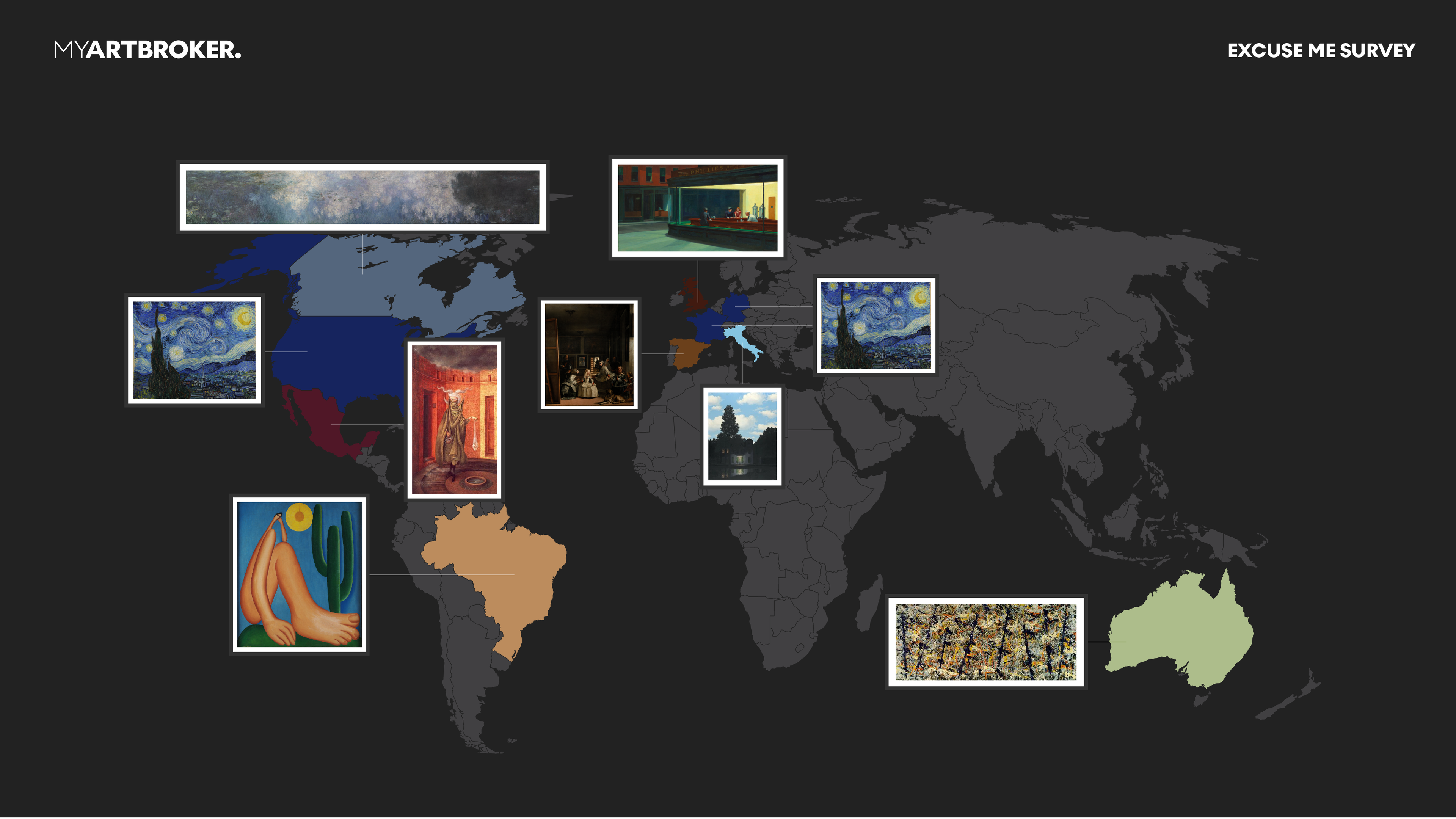
Across these regions, modern icons appear to have a true universality. Hopper’s Nighthawks heads the list in the US and UK and still ranks within the top five in four other countries (Mexico, Germany, Canada, and France). Van Gogh’s Starry Night was in the top 10 artworks across eight different countries, demonstrating the universal appeal of the work thanks to global museum loans, endless reproduction, and a strong presence in school curricula, which has enabled this particular work to firmly transcend language barriers and national borders.
The remainder of each country’s choices are informed by the works held in national collections, or those with a cultural narrative that resonates most with the populace. Spain elected Bosch’s Garden of Earthly Delights to first position – a Netherlandish painting that has hung in Madrid’s Prado for centuries – alongside Velázquez’s Las Meninas, underlining the impact of flagship national museums. Italy’s voters favour classical and literary themes, championing home-grown talent with Bernini and Botticelli. In Brazil, modernist pride takes centre-stage with Tarsila do Amaral’s Abaporu outpacing global favourites. Australia’s inclusion of Pollock’s Blue Poles reflects its status as a touchstone of the National Gallery of Australia. Interestingly, while The Starry Night held first position in France, there is an interesting omission of Monet from the French Top 10. Together, the data shows that universal favourites anchor taste everywhere, but the art that people grow up with, and the stories they tell, continue to steer their personal affinity with it throughout their lives.
Top 5 Artworks Per Country
UK:
- Nighthawks
- The Execution of Lady Jane Grey
- The Lady of Shalott
- The Starry Night
- The Kiss
US:
- The Starry Night
- Nighthawks
- Waterlilies
- The Winged Victory of Samothrace
- Christina’s World
Spain:
- Las Meninas
- The Garden of Earthly Delights
- The Kiss
- Cosiendo la Vela
- Guernica
Italy:
- Empire of Light
- Ophelia
- Apollo and Daphne
- David
- Judith Slaying Holofernes
Australia:
- Blue Poles
- Ophelia
- The Birth of Venus
- The Garden of Earthly Delights
- Anguish, August Friedrich Schenck
Brazil:
- Abaporu
- The Starry Night
- The Birth of Venus
- The Kiss
- Empire of Light
Canada:
- Waterlilies
- Nighthawks
- Ophelia
- The Execution of Lady Jane Grey
- The Garden of Earthly Delights
Mexico:
- Leaving the Psychologist's Office
- Nighthawks
- Papilla Estelar
- Apollo and Daphne
- Composition 8
France:
- The Starry Night
- The Garden of Earthly Delights
- Nighthawks
- The Wanderer Above the Sea of Fog
- Ophelia
Germany:
- The Starry Night
- Girl with a Pearl Earring
- Waterlilies
- The Birth of Venus
- No conclusive fifth position as many works had the same number of votes (Damien Hirst, Leap into the Blue – Yves Klein, Unfinished Painting – Keith Haring, The Monk by the Sea – Caspar David Friedrich, Automat – Edward Hopper, The Kiss – Gustav Klimt, Ophelia – John Everett Millais, The Dance Class – Edgar Degas, The Veiled Virgin – Giovanni Strazza, David – Michelangelo)
Survey Methodology: The findings discussed in this report are based on the raw, unedited responses collected through MyArtBroker’s global Excuse Me survey. The survey ran for six weeks and gathered 7,642 open-ended submissions from respondents across more than 40 countries. All percentages, rankings and insights reflect aggregated self-reported data.