

Key Takeaways
Keith Haring's investment outlook in 2026 is best read through auction trends, average value movement, and the behaviour of key market segments. Use these signals to assess risk, pricing stability, and long-term positioning in the print market.
From 2023, the supply of those top-tier sets tightened materially. Rather than suppressing activity, this shift redistributed value across a wider range of editions and price points. Participation remained consistent, supported by repeat trading across core series and sustained collector interest. By 2025, the market was operating at scale without reliance on headline sets, reinforcing its structural resilience.
Keith Haring Print Market Performance 2021–2026
Is Buying A Keith Haring Print A Good Investment?
Haring’s print market demonstrates a balance that is attractive from an investment perspective: consistent liquidity paired with selective pricing upside. When rare formats circulate, value concentrates quickly; when they don’t, demand shifts laterally across editions rather than retreating.
The scarcity of complete sets after 2022 did not weaken the market. Instead, collectors absorbed available supply across individual editions, trial proofs, and mid-tier works, allowing pricing leadership to evolve without destabilising participation. This behaviour reflects a mature market where confidence is sustained even as supply conditions change.
What Happened in Keith Haring’s Print Market at Auction in 2025?
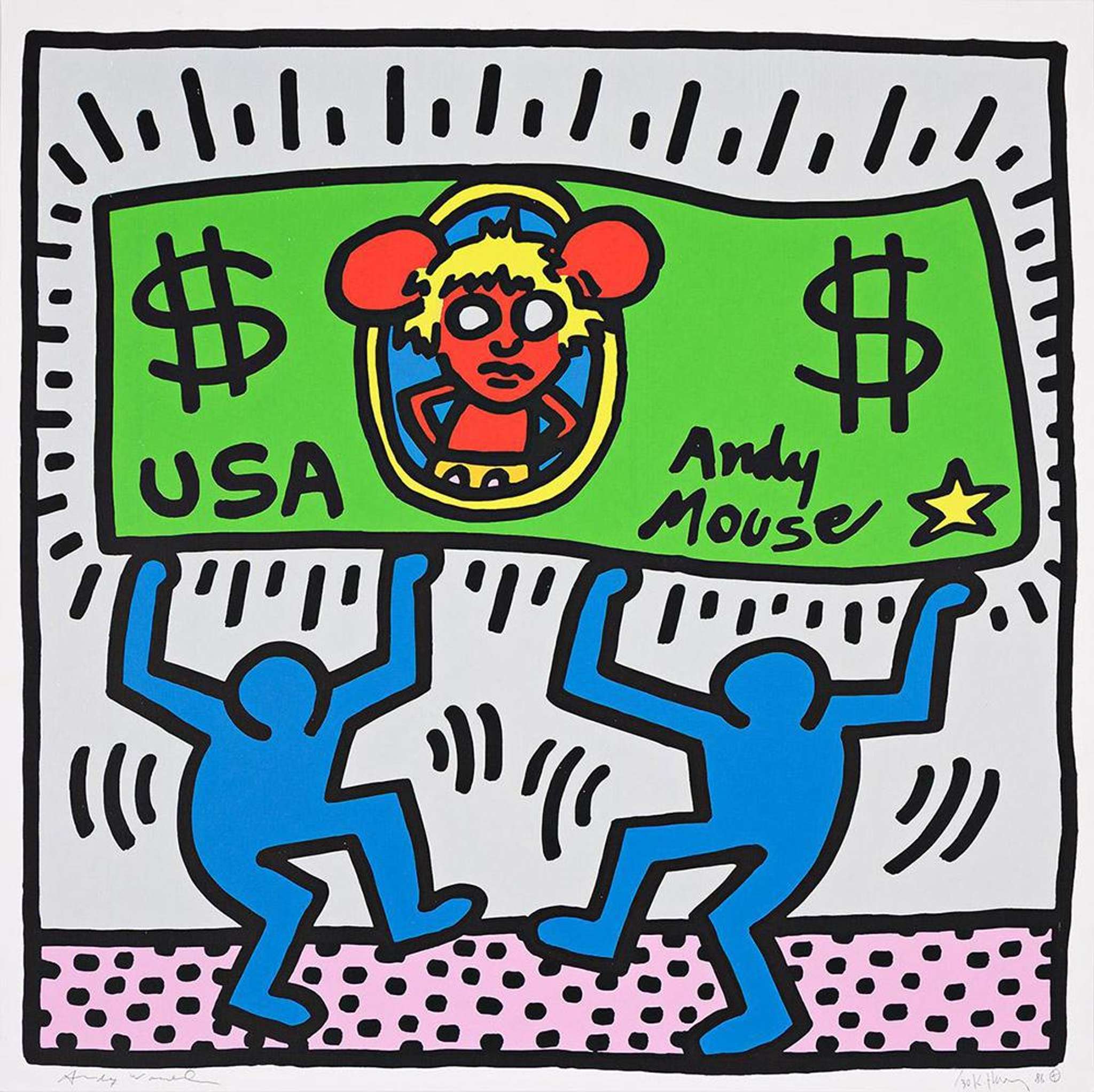
Auction activity in 2025 marked a normalisation phase following the unusually concentrated run of high-value sets between 2021 and 2023. Complete sets such as Andy Mouse were largely absent, but the market remained active through the circulation of high-quality individual editions and selective set material.
Trial proofs from the Growing series emerged at the upper end, while Blueprint Drawings, cut-out editions, and other accessible works traded consistently. The result was a year defined by format rotation rather than retrenchment, with demand sustained even as pricing leadership shifted away from its most extreme tiers.
Keith Haring Average Value 2021–2026
What Is the Average Value of My Keith Haring Print?
Average selling prices in Haring’s print market move with format composition, not volatility. Peaks in average value have historically coincided with the appearance of complete sets and premium editions, while softer averages reflect periods dominated by more accessible works rather than a loss of confidence.
The high average values seen around 2022 were driven by a dense concentration of top-tier material. As those works became scarcer from 2023 onward, averages adjusted downward through broader price dispersion. By 2025, increased trading in Blueprint Drawings, cut-out editions, and Growing trial proofs widened participation while maintaining competitive outcomes for higher-quality works.
Keith Haring Top Performing Collections In 2026
Top Performing Print Collections In Keith Haring's Current Market
Haring’s print market continues to be anchored by collections that combine recognisability, repeat trading, and format flexibility.
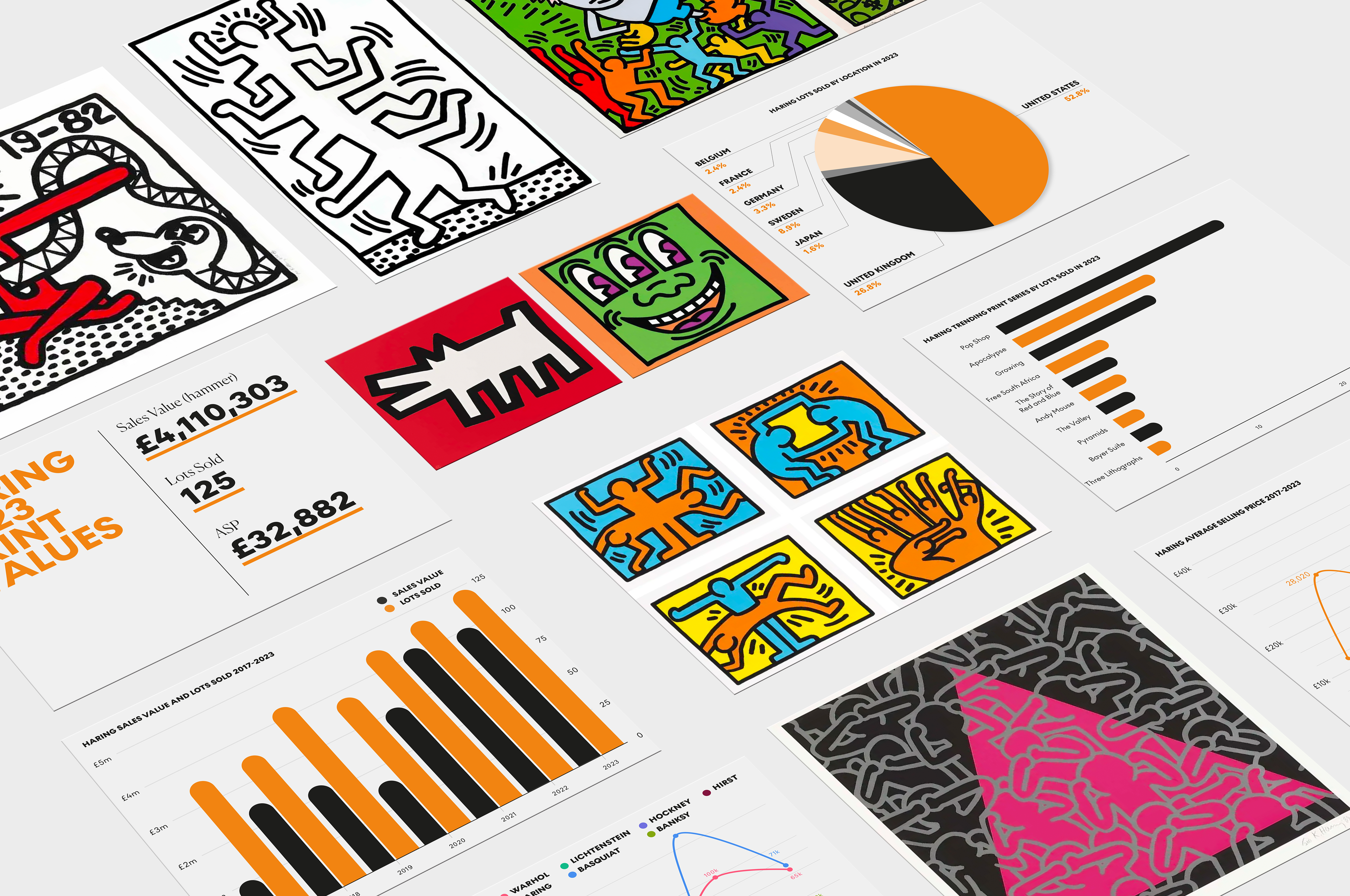
Pop Shop works remain the market’s most consistent performers. Available as signed/unsigned individual prints, complete sets, and quads, they offer pricing variability across formats while trading reliably year on year. Their strength lies in visibility: these works sit at the centre of Haring’s visual legacy and provide a stable foundation for liquidity across multiple price tiers.
Andy Mouse sits at the opposite end of the spectrum. Complete sets have achieved seven-figure results when they appear, while individual prints continue to trade strongly in their own right. This dual structure reinforces Andy Mouse as one of the most structurally important collections in the market.
Other established collections include Dog cut-out editions, Totem works, and Pyramids, which reflect Haring’s experimentation with material through metal and carved plywood. Their limited availability and distinct formats have supported sustained demand across colourways and editions.
At more accessible levels, Blueprint Drawings and Icons play an important supporting role. Blueprints attract collectors seeking lower price points and a more restrained colour palette, while Icons distil Haring’s visual language into single, recognisable motifs, offering consistent entry-level liquidity.
For a data-led view of how these collections rank by confidence, liquidity, and pricing resilience, explore our latest Most Investable Collections Report, where each series is scored using our proprietary confidence framework.
The Most In-Demand Keith Haring Prints from Investors
Investor demand in Haring’s market is increasingly shaped by format rarity and structural completeness, rather than image recognition alone.
Complete sets are emerging as a growing area of focus. While historically rare, sets from series such as Growing and Fertility Suite are appearing more frequently, allowing value to concentrate at the collection level. Growing, in particular, is gaining momentum across both complete sets and individual works, supported by multiple colourways and edition formats.
Alongside sets, investors continue to target Dog works, especially cut-out editions, for their sculptural presence and material distinction. Pricing in this segment is driven by format, colourway, and condition rather than imagery alone.
Blue Chip Print Markets: Comparative Auction Sales Value 2021–2026
What Are the Top Performing Blue Chip Artist Markets?
Among major blue chip print markets, Haring occupies a position defined by consistency rather than extremes. Unlike sentiment-driven markets such as Banksy, which have experienced sharp expansion followed by contraction, Haring’s market has shown steadier participation across cycles, with pricing leadership shifting by format rather than collapsing or accelerating abruptly.
Compared to structurally scaled markets like Andy Warhol, Haring’s market is narrower but more responsive to scarcity. Where Warhol absorbs demand through volume and repeated trading across formats, Haring’s value advances when rarer material surfaces, particularly complete sets and distinctive editions. Relative to David Hockney, Haring’s prints trade more actively at accessible price points, supporting stronger day-to-day liquidity even as top-tier works remain selectively scarce.
For investors, this positions Haring as a balanced blue chip market: less volatile than momentum-led peers, less scale-dependent than Warhol, and structurally supported by recognisable imagery, repeat trading, and episodic scarcity.
Liquidity in Keith Haring’s Print Market
Liquidity in Haring’s print market is driven by a clear split between volume and value. Since 2021, 51% of transactions by volume have occurred below £15,000, supporting frequent trading and making the market highly accessible at entry level.
By contrast, 46% of total sales value is concentrated in works priced above £50,000. This indicates that while most buyers engage at lower price points, capital accumulation is anchored in a small number of high-value works. Liquidity therefore remains strong even when premium material is scarce, with activity redistributing rather than contracting.
For investors, this structure reduces downside risk while preserving upside potential. The market remains easy to enter and exit at scale, while meaningful price leadership emerges selectively when rare or exceptional works appear.
This guide is intended for informational and research purposes only and does not constitute investment advice. All analysis and commentary reflect MyArtBroker’s interpretation of historical and current market data at the time of writing. As market conditions evolve, our views and analysis may change. Individual artworks and editions can perform differently depending on factors such as condition, provenance, timing, and market context. Readers are encouraged to conduct their own research and consult with a specialist before making any acquisition or sale decisions.